



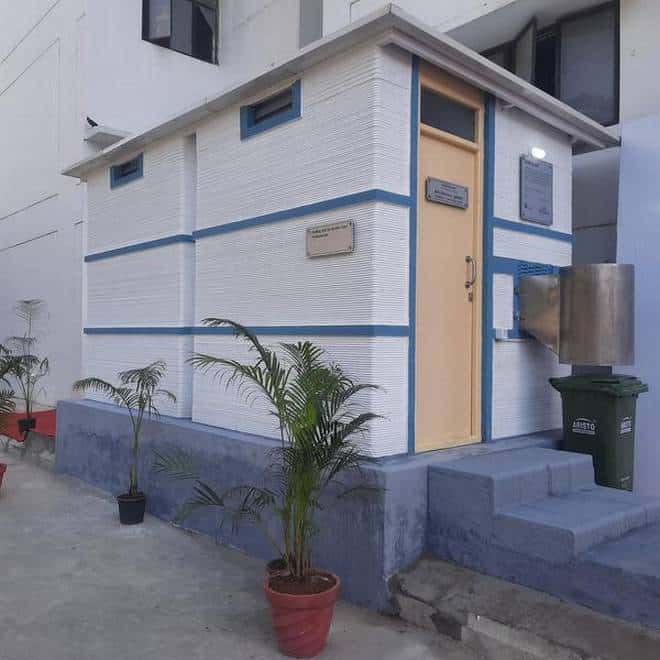
Bangalore-based tech startup Tvasta Manufacturing Solutions (Tvasta), founded by IIT Madras Alumni, revealed that it has collaborated with Saint-Gobain, a French multinational corporation, to develop a 3D printed doffing unit. Two such 3D printed doffing units are installed at two hospitals in Kancheepuram and Chennai.
A doffing unit is used for effective and safe removal and proper disposal of PPE kits now used widely in times of pandemic.
The Health and Family Welfare Minister of Tamil Nadu Hon. Ma. Subramanian commissioned one unit each in the government headquarters hospital in Kancheepuram and the Government Medical College Hospital, Omandurar Estate, Chennai, last week. Along with this, the foundation stone for the third was laid at the Government Medical College and Hospital, Thiruvalluvar.
3D Printed Doffing Unit
The 3D printed doffing units include inbuilt facilities like wash basin, water closet, shower and disposal chute for PPE. The plumbing and electrical lines are integrated along the 3D printed walls. The units comprise an ultraviolet-C sterilisation box, automatic sanitiser dispenser and automatic soap dispensers.
Due to the pandemic situation, doffing units are a must at every hospital and vaccine centre to ensure the doctors dispose-off their PPE kits safely. The units also ensure that the virus does not spread to patients and those coming for vaccinations.
The doffing units were 3D printed at Tvasta’s 3D printing facility in Perungudi, Chennai, and transported to the construction site in a modular manner.
The concrete 3D printing technology is a ‘ready-to-implement methodology’ with no lead time on manufacturing, which significantly reduces the construction time. This ‘Made In India’ technology has the potential to change the term ‘building’ to ‘printing’ in the near future.
Recently, Tvasta also 3D printed India’s first 3D printed house in the IIT-Madras campus. This house was inaugurated by Smt. Nirmala Sitharaman Hon’ble Minister of Finance and Corporate Affairs, Govt. of India.


