
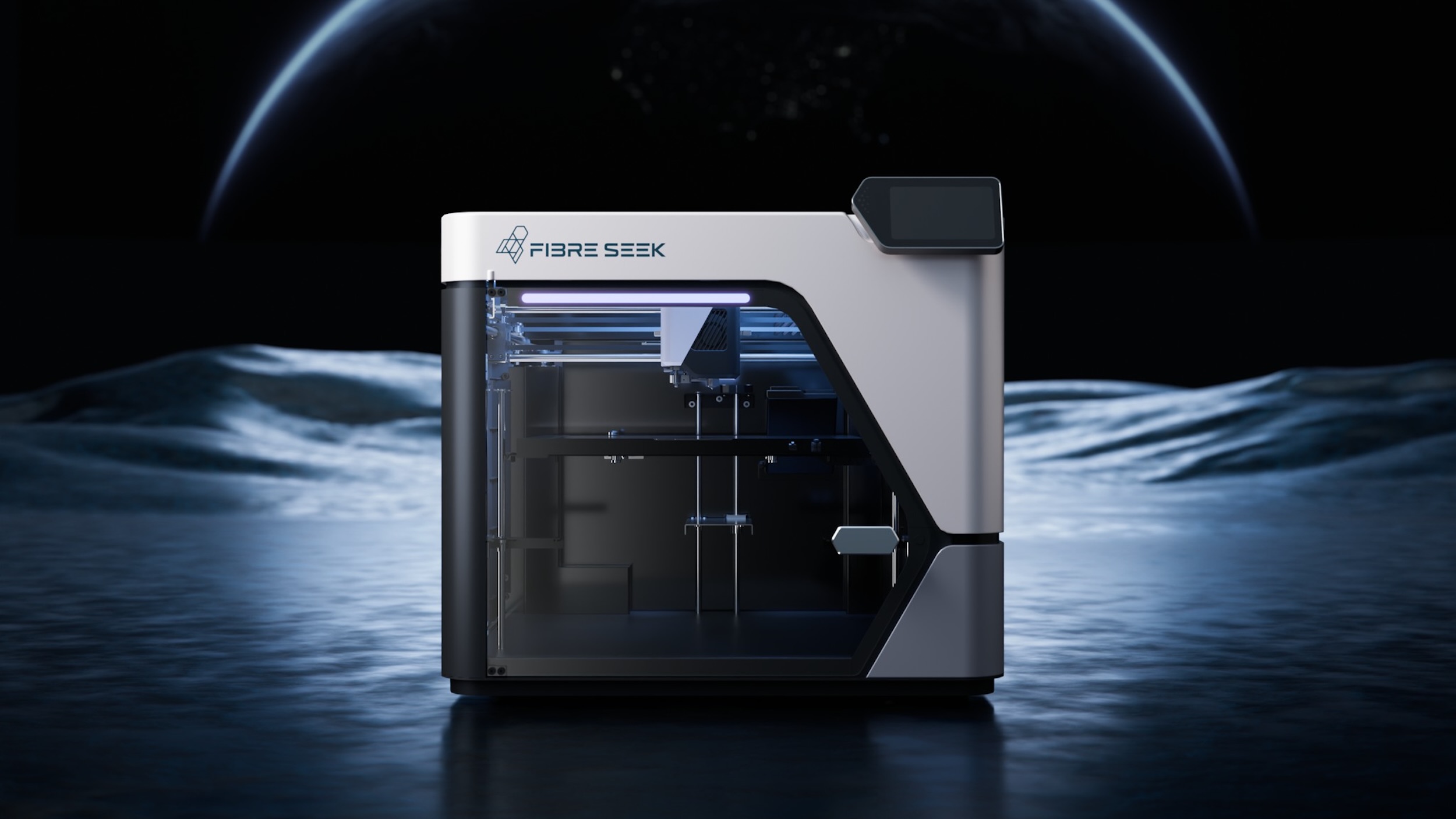
FibreSeek, a continuous fiber 3D printer manufacturer founded by the core team behind Anisoprint, has raised over US $4.7 million on Kickstarter for the FibreSeeker 3, described as the world’s first consumer-grade continuous fiber 3D printer priced under US $3,000. The campaign places the FibreSeeker 3 among the most funded 3D printer projects in the crowdfunding platform’s history.
Continuous fiber 3D printing has historically been confined to industrial sectors such as aerospace and automotive manufacturing, where machines typically cost tens or even hundreds of thousands of dollars. The FibreSeeker 3 represents a significant price reduction, aiming to bring the technology within reach of engineers, makers, and educational institutions.
How the Continuous Fiber 3D Printer Works

Unlike conventional FDM printers that produce plastic parts, the FibreSeeker 3 uses Anisoprint’s proprietary Continuous Fiber Co-extrusion (CFC) technology to embed unbroken carbon fiber filaments into printed components. The process functions similarly to reinforced concrete: as thermoplastic material is melted and extruded, continuous carbon fiber is embedded inside as a structural skeleton. According to FibreSeek, this enables printed parts to reach a tensile strength of 900 MPa, more than ten times that of standard 3D-printed materials and comparable to aluminium alloy.
The printer is paired with Rocket Slicer, a proprietary slicing software that automatically handles fiber path planning. Traditional slicing software cannot manage the complex algorithms required for continuous fiber placement. FibreSeek states that Rocket Slicer’s path-planning algorithm is trained on thousands of experimental datasets, allowing non-specialist users to generate print-ready files without manual fiber routing.
Open Materials and Lower Costs

A central element of FibreSeek’s consumer strategy is its approach to material pricing. Industry incumbent Markforged operates a closed ecosystem, binding its machines to proprietary consumables priced at approximately US $415 per roll. FibreSeek has developed its own X-CCF continuous carbon fiber filament, priced at US $55 per 500 metres, a reduction of approximately 70% against comparable products.
The FibreSeeker 3 also supports an open material system, permitting users to pair the consumer continuous fiber 3D printer with third-party plastic substrates such as PLA, PETG, nylon, and polycarbonate. Rocket Slicer includes a built-in parameter library that adjusts extrusion speed and fiber tension based on the selected material, aiming to ensure consistent mechanical performance across a range of filaments.
A 3D printing media outlet described the Kickstarter campaign as a direct challenge to Markforged’s position in the continuous fiber printing segment.
“What if this technology isn’t just used for rockets worth billions of dollars or racing cars worth millions? What if we turn it into a product that engineers, creators, and even students can use at their desks?”
— Liu Rui, CEO, Anisoprint 3D
Current Limitations of Fiber Printing
Despite its capabilities, the continuous fiber 3D printer carries inherent limitations that prospective users should consider. Fiber-reinforced parts exhibit directional (anisotropic) strength, strong along the fiber path but weaker in perpendicular directions. Designing for continuous fiber printing requires an understanding of load paths that goes beyond standard FDM workflows.
Material options remain narrower than those available in conventional thermoplastic printing, and per-part cost is still higher than standard FDM output, even with FibreSeek’s reduced consumable pricing. The learning curve for fiber path design software, while eased by Rocket Slicer, remains steeper than that of established plastic slicers.
Looking Ahead
FibreSeek’s crowdfunding result signals growing demand for accessible composite manufacturing tools. With the company’s acquisition of the original Anisoprint’s patents, expert team, and global distribution channels, backed by investors including Sequoia Capital and GF Securities, FibreSeek has positioned itself as a notable entrant in the consumer continuous fiber 3D printer segment.
Whether the desktop market can sustain an industrial-grade composite technology at consumer-level pricing remains to be seen, but the FibreSeeker 3 has demonstrated that interest in an affordable continuous fiber 3D printer is substantial.
About Manufactur3D Magazine: Manufactur3D is an online magazine on 3D Printing. Visit our Tech News page for more updates on 3D Printing Technology News. To stay up-to-date about the latest happenings in the 3D printing world, like us on Facebook or follow us on LinkedIn and Twitter.