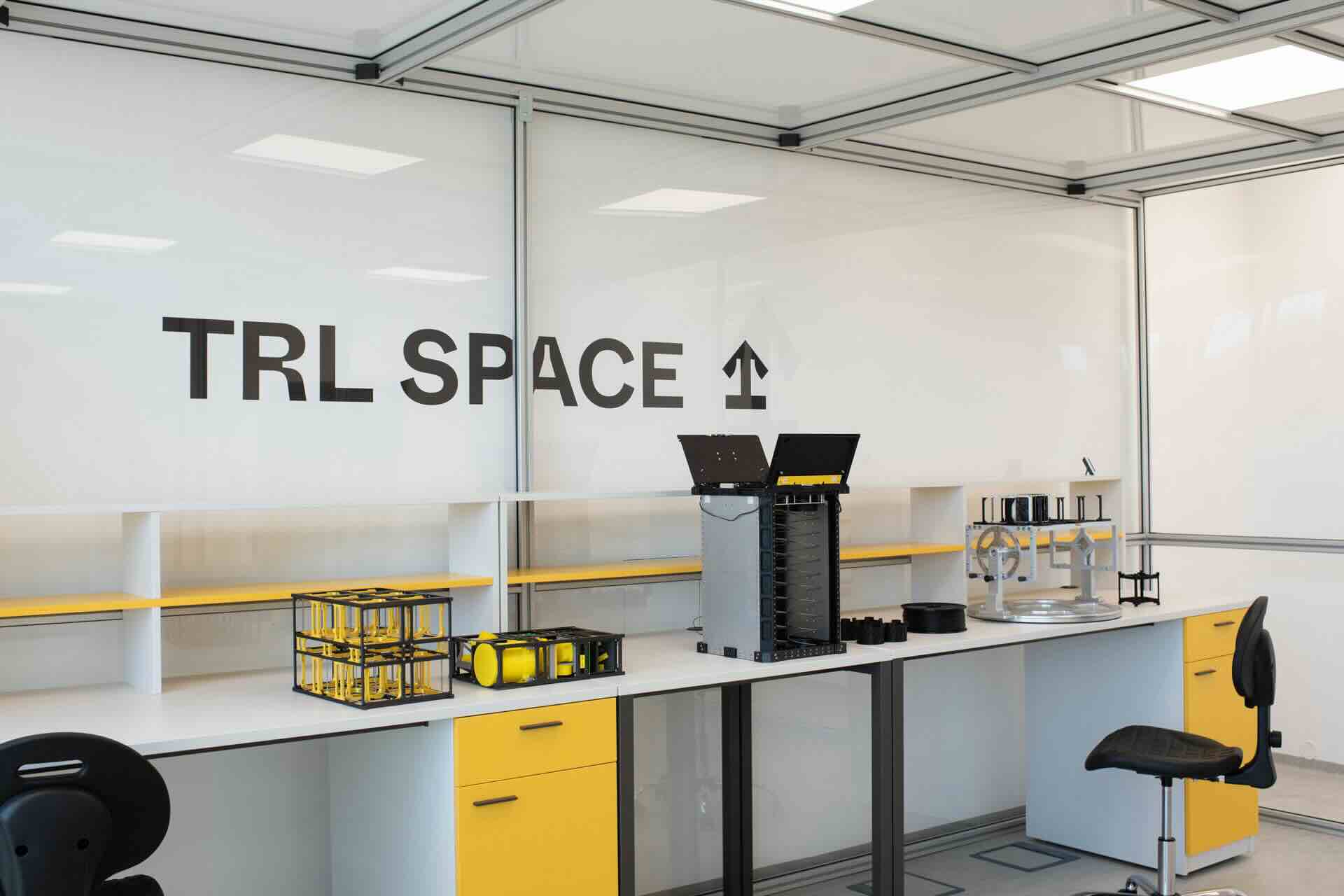
Prusa Research has unveiled Prusament PC Space Grade Black, a revolutionary space-grade filament developed specifically for the aerospace industry and particle physics applications. The Czech-based 3D printing company, known for its desktop printers and materials, has created this ESD-safe polycarbonate filament in collaboration with TRL Space, a Czech space company that provides complete turnkey space missions and works closely with the European Space Agency.
The material represents a significant breakthrough in accessibility for aerospace manufacturing, as it can be printed on standard desktop 3D printers rather than requiring costly industrial equipment traditionally needed for space-qualified materials. Priced at 229 USD or 249 EUR for an 850-gram spool, the filament offers exceptional outgassing properties and electrostatic dissipation capabilities that meet stringent European Space Agency standards, making it suitable for structural components such as CubeSat frames, electronics housings, and wire holders.
Prusament PC Space Grade Black filament

The development of Prusament PC Space Grade Black addresses a long-standing challenge in the aerospace sector where materials suitable for space applications have traditionally been limited to expensive options like PEEK, PEKK, and PEI. These materials require industrial 3D printers costing hundreds of thousands of pounds, creating significant barriers for smaller organisations and research institutions. The new polycarbonate-based material changes this paradigm by offering comparable performance whilst remaining compatible with desktop printers such as the Prusa CORE One, MK4S, and XL models.
TRL Space, based in Brno and part of the TRL Group, brings substantial expertise through its involvement in European Space Agency projects and global space missions. Their experience in developing technologies for Earth orbit and lunar missions helped shape the material specifications to meet real-world aerospace demands, ensuring the space-grade filament delivers practical solutions for actual space applications.
Exceptional Outgassing and ESD Properties

The space-grade filament achieves remarkable outgassing results that surpass European Space Agency requirements by substantial margins. In certified laboratory testing, the material demonstrated a Total Mass Loss (TML) of 0.25 percent against the ESA limit of 1 percent, achieved a perfect 0.00 percent for Collected Volatile Condensable Material (CVCM) versus the 0.1 percent limit, and recorded 0.12 percent for Recovered Mass Loss (RML), well under the 1.0 percent threshold.
These characteristics are critical for space applications, as released gases can contaminate optical devices, damage electronics, or cause inaccurate sensor measurements. Manufacturing thermoplastic polymers with minimal outgassing typically requires expensive industrial-grade materials, making this achievement particularly noteworthy. The material’s electrostatic dissipation properties further enhance its suitability with volume resistivity of 2.2×10⁴ Ω⋅m and surface resistivity of 6×10⁷ Ω/sq, placing it firmly within the dissipative range for protecting sensitive electronic components.
Mechanical Properties Meet Aerospace Standards
Finite Element Method simulations established minimum mechanical requirements for CubeSat structural components. The space-grade filament exceeded all criteria, achieving 75 MPa tensile strength against a 70 MPa requirement, 3.7 GPa tensile modulus versus 2 GPa minimum, and 18 MPa interlayer adhesion, nearly double the 10 MPa threshold. The heat deflection temperature reached 137.6°C at 0.45 MPa load, surpassing the 100°C requirement.
These properties, combined with outgassing and ESD characteristics, position the material as a viable candidate for affordable CubeSat production. The carbon additives provide necessary electrical properties whilst contributing to its distinctive black colour with a satin finish.
Practical Printing and Quality Assurance

Despite advanced properties, Prusament PC Space Grade Black maintains practical printing characteristics on standard desktop equipment. The material exhibits minimal warping, allowing models up to 200x200mm to be printed reliably. Recommended parameters include 290°C nozzle temperature and 120°C bed temperature, using a hardened 0.4mm or larger nozzle. The filament performs well on various print surfaces without requiring an enclosure.
Pre-print preparation involves drying the filament for six hours at 60°C and maintaining it in a dry box during printing. This ensures dimensional accuracy and preserves mechanical and outgassing properties. The entire manufacturing process offers complete traceability, from filament production data through to print progress monitoring via Prusa Connect.
Prusa Research has filed a patent application for this space-grade filament, marking their first material to receive such protection. The company aims to achieve the highest classification for polymers used in space applications as additional test results become available. Current applications include electronics housings and wire holders, with potential expansion to critical structural components pending further certification.
About Manufactur3D Magazine: Manufactur3D is an online magazine on 3D Printing. Visit our Tech News page for more updates on 3D Printing Technology News. To stay up-to-date about the latest happenings in the 3D printing world, like us on Facebook or follow us on LinkedIn and Twitter.