



Wire arc additive manufacturing (WAAM) is a metal 3D printing process that builds parts by melting welding wire with an electric arc, layer by layer, usually guided by an industrial robot. Choose it for large, near-net-shape parts in costly alloys. Skip it when you need fine detail or a finished surface straight off the machine.
WAAM belongs to the directed energy deposition (DED) family. It deposits metal at kilograms per hour rather than grams, so metre-scale parts become practical. The trade-off is resolution: parts come off the robot with wavy walls and almost always need CNC finishing.
This guide is for engineers, buyers and hardware founders weighing WAAM against casting, forging, machining or powder-based metal printing. It covers how the process works, the parameters that control quality, which metals it handles, what it costs and when it is the wrong choice.
What is WAAM, and how is it different from welding?
WAAM is an additive process that combines three mature technologies: an arc welding power source, solid wire feedstock and a multi-axis motion system such as a six-axis robot. Every layer is a weld bead, but the beads are stacked under tight control to form a freestanding 3D part.
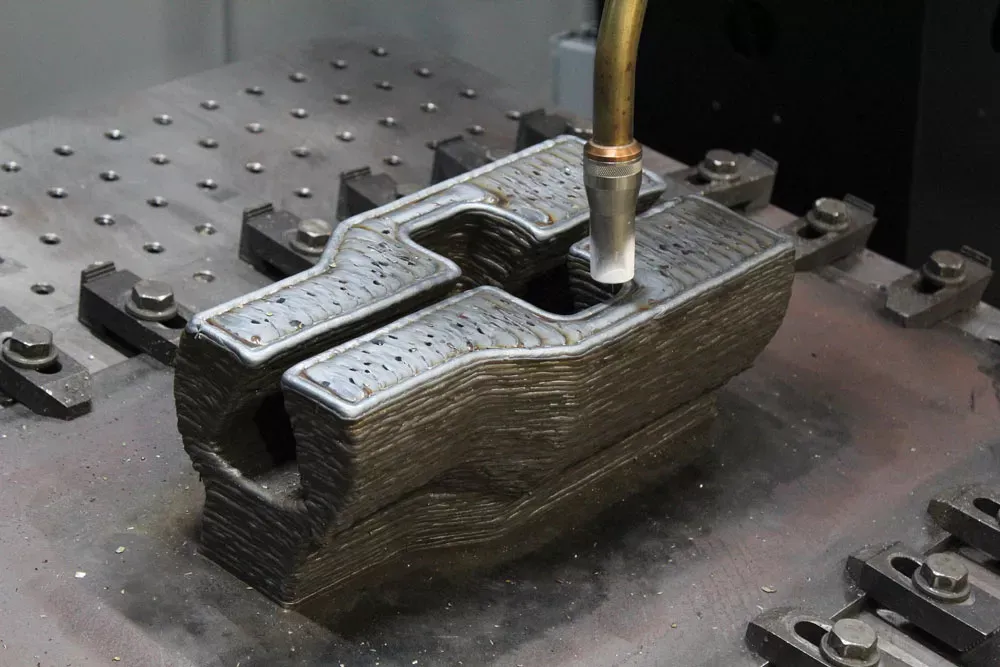
Under ISO/ASTM 52900:2021, the standard that sets additive manufacturing terms, WAAM is a form of directed energy deposition. DED means energy and material arrive at the same point at the same time, and the melt pool freezes as the torch moves on. Laser DED uses a laser and usually powder. WAAM uses an electric arc and wire.
The idea is older than most people assume. Patents on "shape welding" go back to the early twentieth century. The modern research programme grew at Cranfield University in the UK, which later spun out the company WAAM3D. Commercial systems now come from firms such as MX3D (Netherlands), WAAM3D (UK), Gefertec (Germany), AML3D (Australia) and Lincoln Electric (USA).
Is WAAM just welding by another name?
Physically, yes: each WAAM bead is a weld bead. The difference is intent and control. A welder joins two parts with a few passes. WAAM stacks hundreds or thousands of beads into a shape, so heat input, interpass temperature, bead geometry and toolpath must be planned by software and checked by sensors, not left to a welder's hand.
How does wire arc additive manufacturing work?
A WAAM build follows the usual digital chain of design, slicing, deposition and finishing, with welding-specific steps added. You slice the CAD model into 1–3 mm layers, deposit beads with a robot-held torch, manage heat between layers, then machine and test the near-net-shape part.
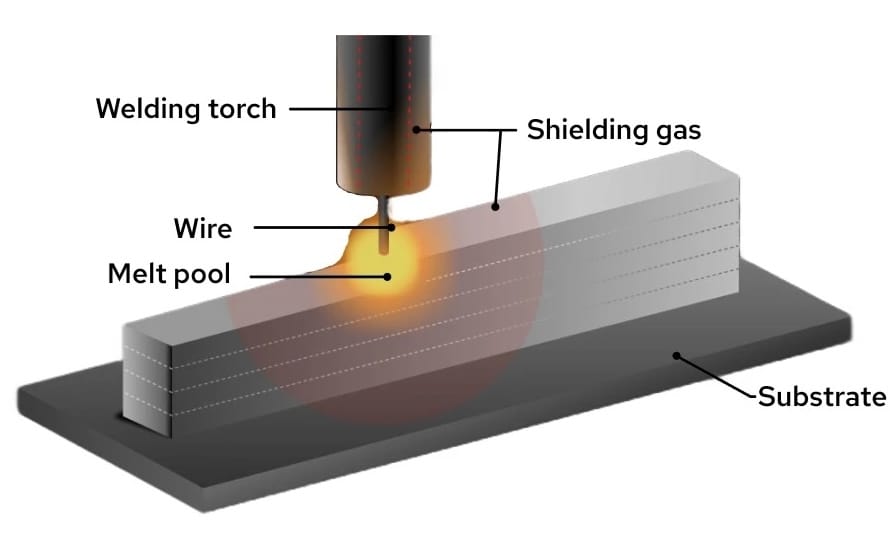
1. Design and slicing
The CAD model is cut into layers, typically 1–3 mm thick. WAAM software must also plan bead width and overlap, start and stop points (where defects tend to form), torch angle and build order to manage heat. Most teams add a machining allowance of about 1–3 mm per surface from day one.
2. Arc deposition
A torch moves along the programmed path while wire feeds into the arc. Three arc process families dominate, plus one important low-heat variant:
- GMAW (MIG/MAG): the wire is the electrode. It is fast, simple and the most common route.
- CMT (Cold Metal Transfer): a low-heat GMAW variant developed by Fronius that pulls the wire back on each short circuit to cut spatter and heat.
- GTAW (TIG): a tungsten electrode makes the arc and wire is fed separately. It is slower but cleaner, and often chosen for titanium.
- PAW (plasma arc): a narrowed arc with higher energy density, used for titanium and high-value alloys.
Shielding gas (argon, argon-CO₂ or argon-helium) protects the melt pool. Reactive metals such as titanium need trailing shields or a local inert enclosure.
3. Heat control between layers
Each new layer reheats the layers below. If the part runs too hot, beads slump, grains coarsen and distortion grows. Operators set a maximum interpass temperature, pause between layers, build several features in rotation or cool the base plate.
4. Post-processing
A WAAM part leaves the cell as a near-net-shape preform. The usual follow-on steps are:
- Stress relief or solution heat treatment
- CNC machining of functional surfaces
- Non-destructive testing (ultrasonic, radiography or CT, depending on size)
- In some cells, hybrid processing, where deposition and machining alternate on one machine
Which process parameters control WAAM quality?
WAAM quality is set by a handful of linked parameters: wire diameter, wire feed speed, travel speed, layer height, interpass temperature and shielding gas. Heat input, roughly arc power divided by travel speed, matters most. Too much causes slumping and distortion; too little causes lack of fusion.
The ranges below are indicative for Gas Metal Arc Welding (GMAW) or Cold Metal Transfer (CMT) builds in steel and aluminium.
| Parameter | Typical range | What it controls |
|---|---|---|
| Wire diameter | 0.8–1.6 mm (1.2 mm is common) | Deposition rate, bead size |
| Wire feed speed | About 3–10 m/min | Deposition rate, heat input |
| Travel speed | About 0.2–1 m/min | Bead width and height, heat input |
| Layer height | About 1–3 mm | Resolution, build time |
| Bead width | About 3–10 mm per pass | Minimum wall thickness |
| Interpass temperature | Alloy-dependent; lower for aluminium than steel | Distortion, microstructure, slumping |
| Contact tip-to-work distance | About 10–20 mm | Arc stability |
Which metals can you print with WAAM?
WAAM prints most metals sold as welding wire: carbon and low-alloy steels, stainless steels, nickel alloys, titanium, aluminium and copper alloys. Wire is cheap, widely certified and safer to store than powder. MX3D estimates that metal powder often costs five to ten times more per kilogram.
That cost figure comes from MX3D's analysis of WAAM cost against machining and powder AM. The table below matches common wire grades to typical uses.
| Material family | Example wire grades | Typical applications | Main watch-out |
|---|---|---|---|
| Carbon and low-alloy steel | ER70S-6, ER110S | Structural parts, tooling | Most forgiving; best place to start |
| Stainless steel | 308L, 316L, duplex 2209 | Oil and gas, marine, architecture | Phase control in duplex grades |
| Nickel alloys | Inconel 625, 718 | Energy, aerospace, chemical plant | High value makes billet scrap costly |
| Titanium alloys | Ti-6Al-4V | Aerospace brackets and frames | Needs strict inert shielding; TIG or plasma |
| Aluminium alloys | ER4043, ER5183, 2319 | Aerospace, automotive, marine | Hydrogen porosity and heat build-up |
| Copper alloys | Nickel-aluminium bronze, CuSi | Ship propellers, marine fittings | Large castings are the usual target |
As-deposited WAAM steels can reach tensile properties close to wrought or cast metal. But the properties are often anisotropic: they differ between the build direction and the travel direction, because grains grow up through the layers. If you need to qualify a part, test samples cut in more than one direction.
How does WAAM compare with powder bed fusion and machining?
WAAM wins on part size, deposition speed and feedstock cost. Laser powder bed fusion (LPBF) wins on detail and internal features. Machining from solid wins on surface finish but wastes the most material when you start from an expensive forging. Your part's size and alloy usually decide.
For WAAM, MX3D typically achieves average deposition rates of 3–4 kg per hour as against 0.03–0.1 kg per hour for LPBF (according to EPRI).
| Factor | WAAM | Laser powder bed fusion | Laser/powder DED | CNC from billet |
|---|---|---|---|---|
| Deposition rate | About 1–3 kg/h | About 0.03–0.1 kg/h per laser | About 0.1–1 kg/h | Not applicable |
| Feedstock | Welding wire | Atomised powder | Powder or wire | Billet, forging, plate |
| Typical part size | Up to metres; limited by robot reach | Usually under about 0.5 m | Up to about 1–2 m | Limited by stock and machine |
| Surface and accuracy | Coarse, wavy walls | Fine detail, internal channels | Medium | Excellent |
| Material waste | Low, plus machining allowance | Low, plus supports | Low | High; up to 80% on forged parts |
For a closer look at how WAAM sits next to two other metal routes, see our comparison of DMLS, binder jetting and WAAM.
Is WAAM a DED process?
Yes. WAAM is a subset of directed energy deposition. In practice, people often say "DED" to mean laser-based systems, so a "WAAM vs DED" comparison usually means arc-and-wire versus laser-and-powder. Arc systems give up the laser's precision in exchange for faster deposition and lower capital cost.
Where is WAAM used today, including in India?
WAAM is used where parts are large, low-volume and made from costly alloys: ship propellers, oil and gas valve bodies and clamps, aerospace structures, architectural steelwork, composite layup tools and repairs. In India, heavy engineering, defence, railways and shipbuilding are the natural fits.
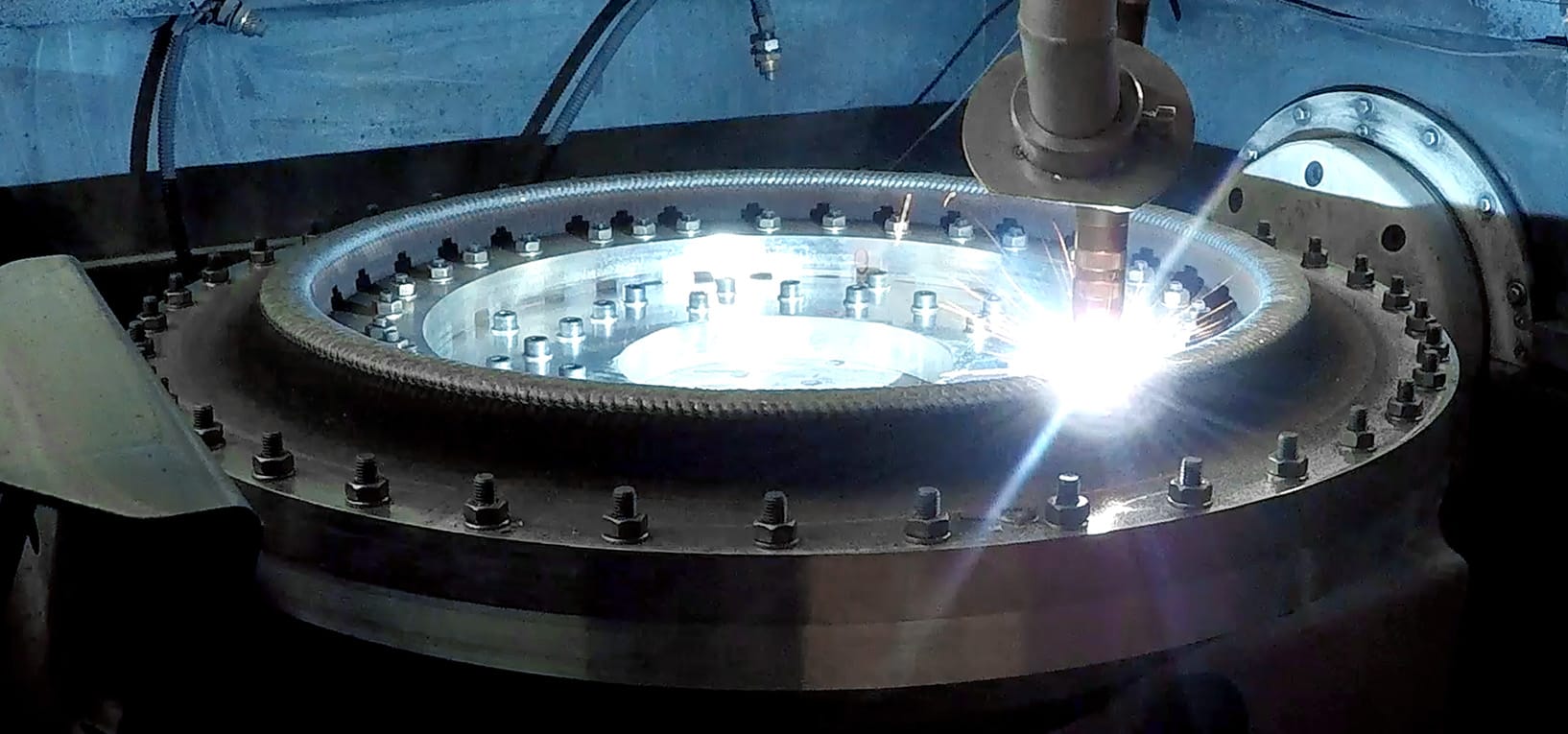
Marine and shipbuilding
Ship propellers are close to a textbook WAAM part. They are large, made from nickel-aluminium bronze, built in small numbers and usually cast with long lead times. In 2017, the Rotterdam-based RAMLAB consortium produced the "WAAMpeller", the first class-approved WAAM ship propeller, certified by Bureau Veritas.
Oil, gas and energy
Valve bodies, pressure-vessel nozzles, pipeline clamps and flanges in stainless steel and nickel alloys are typical. MX3D reports a pipeline clamp that took 16 weeks as a forged and machined part. Printed with WAAM, it took about 3 weeks and produced over 70% less scrap.
Aerospace and defence
Large titanium and aluminium structures appeal because conventional routes machine away most of an expensive forging. A lower buy-to-fly ratio (metal bought versus metal that ends up in the part) is the core business case.
Construction and architecture
The MX3D Bridge, a 12-metre stainless steel footbridge printed by robots, opened over an Amsterdam canal in July 2021. It remains the best-known WAAM part at building scale.
Tooling and repair
WAAM builds Invar layup tools for composites and adds or restores material on existing parts, such as worn surfaces or new bosses on castings. Here the line between additive manufacturing and cladding blurs.
WAAM in India
Fronius's WAAM technology has been distributed in India through Shree Rapid Technologies, as Manufactur3D reported in 2021. Laser-based DED has also reached India's space programme, as our story on the AddUp Magic 800 DED printer shows. For research on how WAAM fits with machining, read our coverage of WAAM in the additive-subtractive process chain.
What are the advantages and disadvantages of WAAM?
WAAM's main strengths are fast deposition, cheap wire feedstock, a build size limited only by robot reach and lower capital cost. Its main weaknesses are coarse resolution, mandatory machining, residual stress, direction-dependent properties and a heavy qualification burden for regulated parts.
Advantages
- High deposition rate: kilograms per hour, which makes metre-scale parts practical.
- Low feedstock cost: standard welding wire is cheap, safe to handle and widely certified.
- Large build envelope: size is set by robot reach and positioners, not a sealed powder chamber.
- Lower capital cost: cells use industrial robots and welding power sources.
- Less scrap: near-net-shape deposition wastes far less metal than machining a forging.
- Shorter lead times: builds can replace long-lead castings and forgings for spares and one-offs.
Build size matters more than most buyers expect. I once worked on a project that had to be cut into four pieces to fit the printer. The joints then had to be as strong as the parts themselves, or the whole project would fail. With WAAM, a robot on a positioner removes most of that splitting and joining risk for large metal parts.
Disadvantages
- Low resolution: bead widths of several millimetres rule out fine features, thin walls and lattices.
- Mandatory machining: almost every functional surface needs a CNC pass.
- Residual stress and distortion: base plates warp, and parts can move when unclamped.
- Anisotropy: properties vary with build direction and thermal history.
- Start-stop defects: porosity (especially in aluminium), lack of fusion and humping need careful path planning.
- Qualification burden: certifying parts for regulated sectors still takes extensive testing.
- Skills gap: you need both welding metallurgy and additive manufacturing know-how in one team.
How much does WAAM cost?
WAAM part cost depends on three things: the machine, the wire and the post-processing. Wire is far cheaper than powder, and robotic cells cost less than large powder bed machines. But machining, heat treatment and testing can take a large share of the final part cost.
- Machine cost: a cell built from an industrial robot, a welding power source, a positioner and software costs well below a large-format LPBF system. Turnkey systems with monitoring and enclosures cost much more than research cells, and vendors quote on request.
- Material cost: wire costs a fraction of powder per kilogram. For titanium or Inconel, buy-to-fly savings often outweigh everything else.
- Post-processing cost: machining, heat treatment and NDT (non-destructive testing) add up fast. Keeping the machining allowance small is one of the biggest levers you have.
WAAM cost can vary widely depending on the size of the part and the material. It can even be as low as $100 (Rs.9500) to $10000 (Rs.9.50 Lakhs) for parts larger than 30-40 kgs.
When should you avoid WAAM?
Avoid WAAM when your part is small, detailed or cheap to machine, when you need internal channels or thin walls, or when you cannot add a machining and inspection step. WAAM pays off only when size, alloy cost and lead time all point the same way.
| Choose WAAM when… | Avoid WAAM when… |
|---|---|
| The part is large (hundreds of mm to metres) | The part fits an LPBF build volume and needs fine detail |
| The alloy is expensive and the buy-to-fly ratio is high | The part is cheap, simple and easy to machine from stock |
| Casting or forging lead time is the bottleneck | Volumes are high enough to justify tooling |
| You already have CNC capacity for finishing | You cannot add a machining and NDT step |
| You need to repair or add features to existing parts | Internal channels, lattices or thin walls are essential |
Match the process to the part, not to the price tag or the buzz. When I first started making prototypes, I chose a printer mainly on price instead of matching the technology to my needs. That cost me many hours of frustration chasing precision from a machine never built for it. The same trap waits for anyone who buys a WAAM cell to make small, detailed parts.
What should you do next if WAAM looks like a fit?
Start with one real part, not a machine purchase. Pick a large component in an expensive alloy with a long casting or forging lead time, get a WAAM build and a conventional quote for the same drawing, then compare total cost, lead time and test results.
Three trends are making that comparison easier each year:
- Closed-loop control: cameras, laser profilers and thermal sensors that adjust settings in real time to keep beads in specification.
- Hybrid cells: deposition and machining in one cell, which cuts handling time and improves accuracy.
- Standards and approvals: growing guidance from classification societies and standards bodies, including the ASTM F42 committee on additive manufacturing, is making WAAM parts easier to certify for marine, energy and defence use.
If you are new to metal printing in general, our explainer on which industries metal 3D printing suits is a useful first read.
FAQs: Wire Arc Additive Manufacturing
What is the difference between WAAM and laser powder bed fusion?
WAAM melts wire with an electric arc in open space and builds large, near-net-shape metal parts quickly. Laser powder bed fusion melts thin layers of metal powder with a laser inside a sealed chamber and makes smaller, highly detailed parts much more slowly. WAAM suits big parts in costly alloys; laser powder bed fusion suits small, complex parts with internal channels.
Can WAAM print titanium?
Yes. Ti-6Al-4V is one of the most studied WAAM alloys, used for aerospace brackets and frames. Titanium reacts with oxygen at high temperature, so WAAM titanium builds need strict argon shielding, often with a trailing shield or local enclosure. Most titanium WAAM work uses TIG or plasma arc processes rather than MIG, because they give cleaner, more controllable deposition.
What safety precautions does a WAAM cell need?
A WAAM cell carries the same hazards as robotic arc welding: ultraviolet arc light, welding fumes, hot metal, electrical risk and robot motion. Typical controls include a guarded robot cell with interlocks, fume extraction at the torch, arc-flash screens and shielding-gas monitoring in enclosed spaces. Follow the welding wire's safety data sheet and your robot maker's safety manual for specific limits.
What file format and software does WAAM use?
WAAM starts from a standard CAD model, often exported as STEP or STL. Dedicated WAAM slicing software then turns the model into robot toolpaths with bead width, overlap, start and stop points and torch angles. Many vendors supply their own path-planning software, and some offline robot programming tools now include WAAM modules for deposition planning.
Can WAAM be used to repair existing metal parts?
Yes. WAAM can add metal to worn shafts, damaged flanges or eroded marine fittings, then the repaired area is machined back to size. Repair works best when the base metal is weldable and the damaged zone is easy for the torch to reach. For critical parts, the repair procedure usually needs the same qualification testing as a weld repair.


