



Electron beam melting (EBM) is a metal 3D printing process that melts metal powder with a focused electron beam inside a vacuum, layer by layer, to make fully dense parts. Choose it for titanium and crack-prone alloys printed in batches. Pick laser powder bed fusion when you need fine detail or a wider choice of metals.
EBM is part of the powder bed fusion family, so you will also see it called electron beam powder bed fusion (EB-PBF or PBF-EB). The whole powder bed is kept hot, at about 600–1,100 °C, so parts come out with very low residual stress. That is why EBM leads in porous titanium hip implants and in titanium aluminide turbine blades, which tend to crack in laser machines.
This guide is for engineers, buyers and hardware founders who want to know whether EBM suits a part. It covers how the process works, the settings that control quality, which metals it prints, where it is used, how it compares with laser printing, and when it is the wrong choice.
What is electron beam melting?
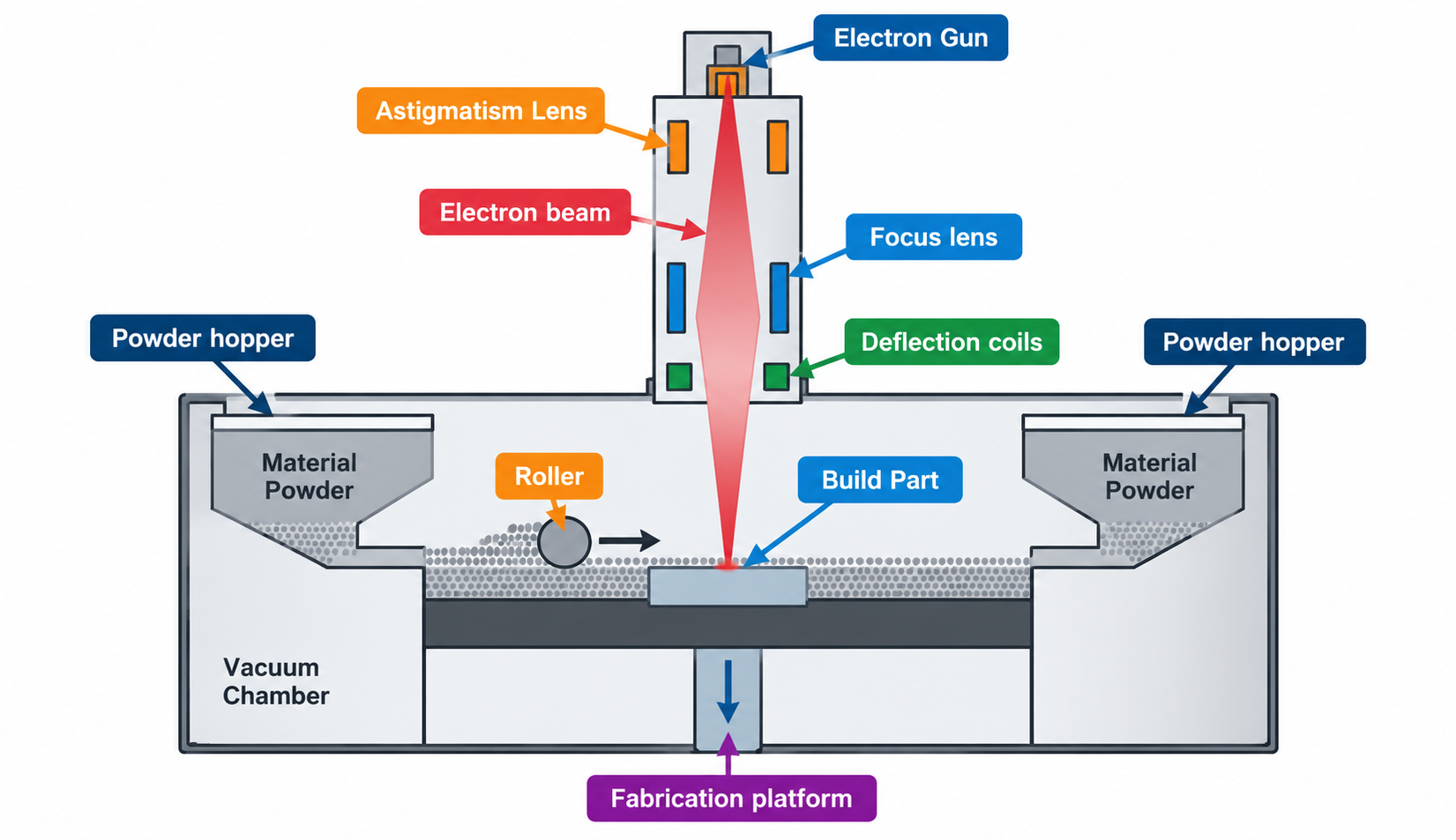
Electron beam melting is an additive process in which an electron gun fires a high-energy beam at a thin layer of metal powder. The beam melts one slice of the part. The platform then drops, fresh powder is spread, and the cycle repeats until the part is finished.
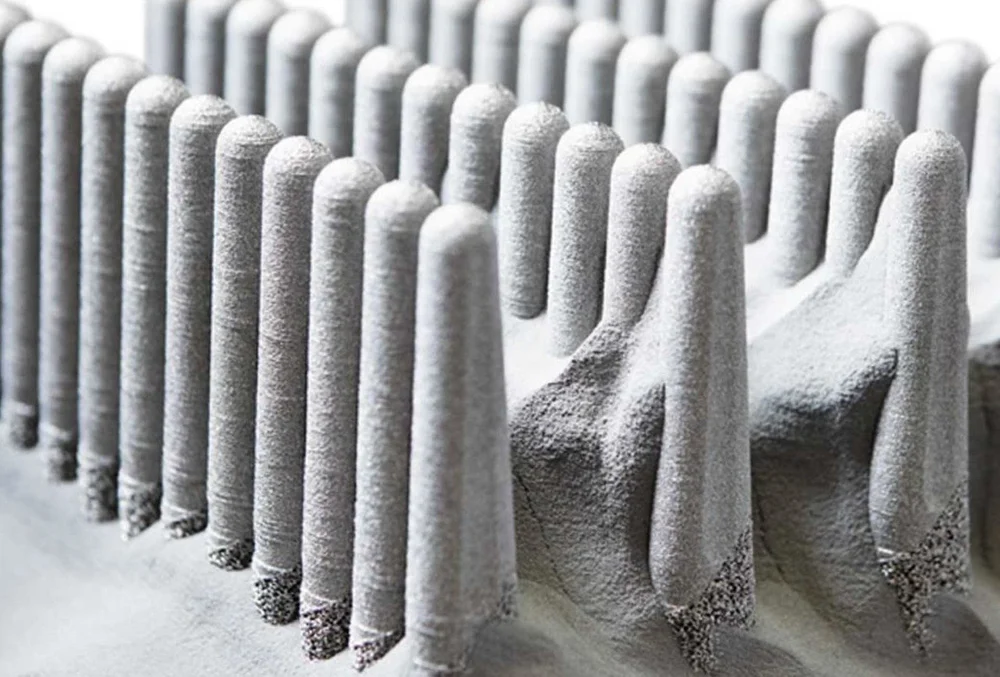
Three things set EBM apart from other metal 3D printing processes:
- The energy source is electrons, not light. Magnetic coils steer the beam instead of moving mirrors, so it can jump across the bed almost instantly.
- Everything happens in a vacuum. Electrons scatter in air, so the chamber is pumped down before printing starts.
- The powder bed runs hot. Each layer is preheated before melting, so the part is built close to the temperature at which metal relieves its own stress.
The technology was commercialised by the Swedish company Arcam, founded in 1997 on research from Chalmers University of Technology. GE bought Arcam and Concept Laser in November 2016 to form GE Additive. In April 2024, GE Aerospace renamed the business Colibrium Additive, which still sells the EBM machine line.
One search tip: "electron beam melting" is also the name of a refining process in which electron beam furnaces melt and purify ingots of titanium, tantalum and other reactive metals. That process is not 3D printing. This article covers only the additive process.
Is electron beam melting additive manufacturing?
Yes. Electron beam melting is additive manufacturing because it builds parts by adding material one layer at a time from a 3D model, instead of cutting material away. The ISO/ASTM 52900 standard places it in the powder bed fusion category, next to laser powder bed fusion and polymer SLS.
ISO/ASTM 52900:2021 is the standard that sets additive manufacturing terms. It groups processes by how they join material. EBM sits in powder bed fusion with laser powder bed fusion (L-PBF, sold under names such as SLM and DMLS) and polymer processes such as SLS and HP Multi Jet Fusion.
Do not confuse EBM with electron beam additive manufacturing (EBAM). EBAM is a wire-fed directed energy deposition process for very large metal structures. EBAM melts wire; EBM melts powder in a bed.
For a wider map of the process families, see our guide to the 7 types of additive manufacturing technologies and our list of metal 3D printing technologies.
How does electron beam melting work?
An EBM build runs through six stages: vacuum pump-down, beam generation, powder spreading, preheating, melting and cool-down. The preheat step is what makes EBM unusual. It keeps the whole bed hot and lightly sintered, which cuts residual stress and stops the powder from blowing apart.
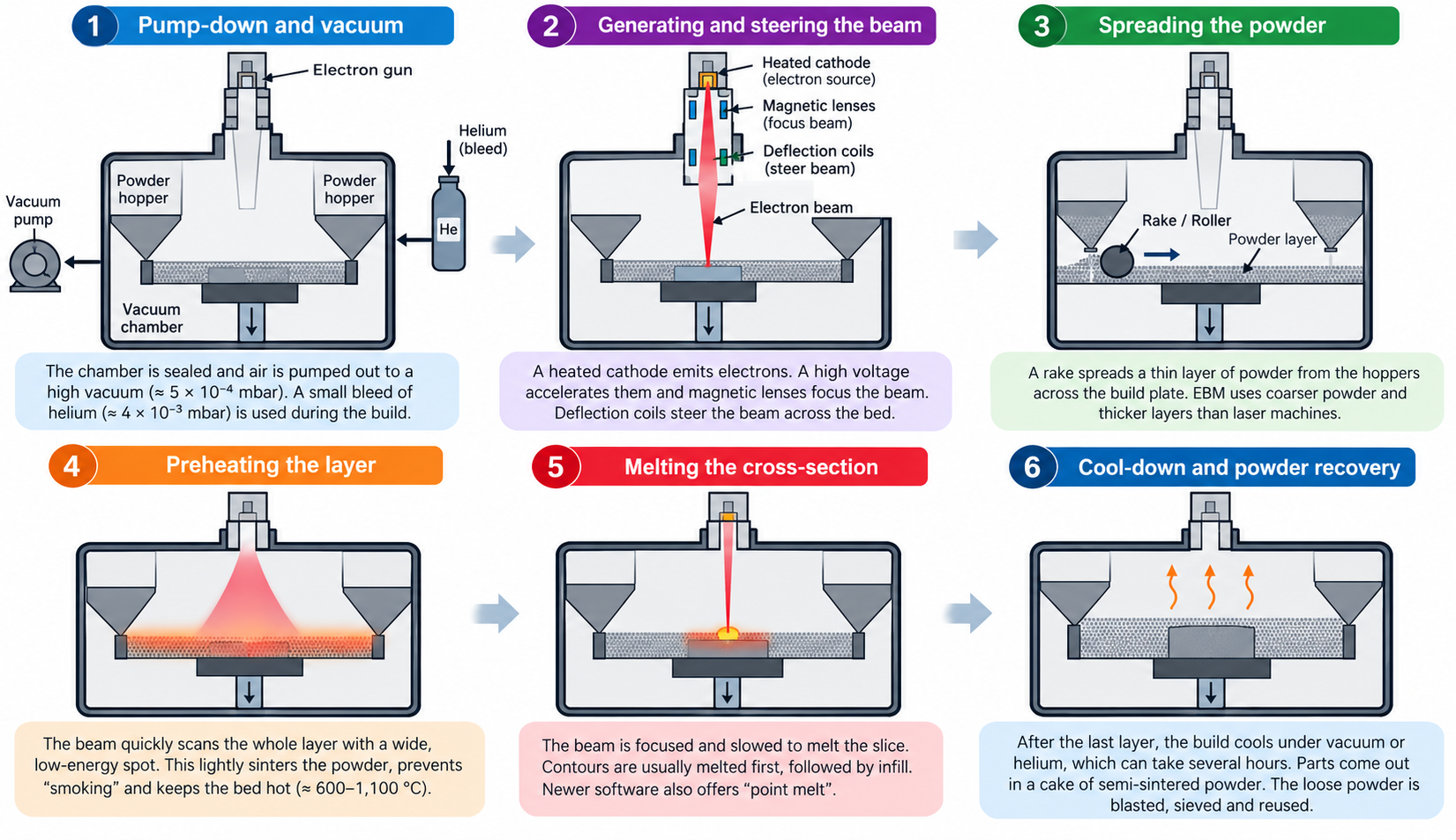
1. Pump-down and vacuum
The chamber is sealed and the air is pumped out. Colibrium's Spectra H brochure lists a minimum chamber pressure of 5 × 10⁻⁴ mbar. A small bleed of helium, at a typical partial pressure of 4 × 10⁻³ mbar, steadies the beam during the build. The vacuum also keeps oxygen and nitrogen away from titanium, which is why EBM titanium has such clean chemistry.
2. Generating and steering the beam
Inside the electron gun, a heated cathode gives off electrons. A high voltage speeds them up, and magnetic lenses focus them into a fine beam. Deflection coils then steer it across the bed. Nothing physical moves, so the beam can scan far faster than a mirror-driven laser and can hold several melt pools at once.
3. Spreading the powder
A rake spreads a thin layer of powder from the hoppers across the build plate. EBM uses coarser powder and thicker layers than laser machines. That is a big reason it is fast but less detailed.
4. Preheating the layer
Before melting, the beam sweeps the whole layer quickly with a wide, low-energy spot. This lightly sinters the powder particles together. The step matters for two reasons:
- It stops "smoking". Powder hit by electrons builds up negative charge. Loose particles then push each other away and blow out of the bed in a cloud. A lightly sintered bed conducts well enough to drain that charge.
- It keeps the part hot. The bed stays at roughly 600–1,100 °C, depending on the alloy. The part never sees the steep temperature swings that cause warping and cracking in laser machines.
5. Melting the cross-section
The beam is then focused and slowed to melt the slice. Contours are usually melted first, then the infill. Newer software also offers "point melt", where the beam melts separate spots in a set order instead of tracing lines. That gives you more control over heat input and grain structure.
6. Cool-down and powder recovery
After the last layer, the build cools under vacuum or helium, which can take several hours. The parts come out inside a "cake" of semi-sintered powder. A powder recovery system blasts the cake with the same alloy powder, so the loose material can be sieved and reused without contamination.
Which process parameters control EBM quality?
Beam power, bed temperature, layer thickness and powder size decide how fast an EBM machine builds and how fine the detail is. EBM runs thicker layers and coarser powder than laser machines. You gain speed and low stress, and you give up surface finish and small features.
The table below gives typical ranges as of October 2026. Exact values depend on the machine, alloy and parameter set, so use them for orientation, not for qualification work.
| Parameter | Typical EBM value | Why it matters |
|---|---|---|
| Beam power | 3–6 kW (Spectra H: 6 kW; Spectra L and M: 4.5 kW) | Higher power means faster preheating and melting |
| Chamber atmosphere | Vacuum of 5 × 10⁻⁴ mbar minimum, with a helium bleed of about 4 × 10⁻³ mbar | Stops beam scatter and oxidation |
| Powder bed temperature | 600–1,100 °C | Low residual stress; allows crack-prone alloys |
| Layer thickness | Usually 50–100 µm (laser PBF: 20–50 µm) | Thicker layers build faster but show coarser steps |
| Powder particle size | About 45–105 µm for Ti-6Al-4V | Coarse powder flows well but limits fine detail |
| Build envelope | Ø350 × 430 mm (Spectra L); 250 × 430 mm (Spectra H); Ø270 × 430 mm (Spectra M) | Sets the largest single part and how many you can nest |
Layer and powder figures come from a 2022 peer-reviewed study of EB-PBF Ti-6Al-4V in the journal Materials. Machine figures come from Colibrium's brochures for the Spectra H, Spectra L and the Spectra M launch.
Surface finish is the trade-off most first-time buyers underestimate. The same 2022 study measured side-wall roughness (Ra) of 39–60 µm on high-layer-thickness builds, against 5–10 µm on top faces. Plan to machine every sealing face, bearing seat and thread.
Which metals can electron beam melting print?
EBM can only print metals that conduct electricity, because the powder bed must drain the beam's charge. The commercial list is short and led by titanium: Ti-6Al-4V, titanium aluminide, nickel alloy 718, cobalt-chrome and some tool steels. Aluminium and polymers are not practical.
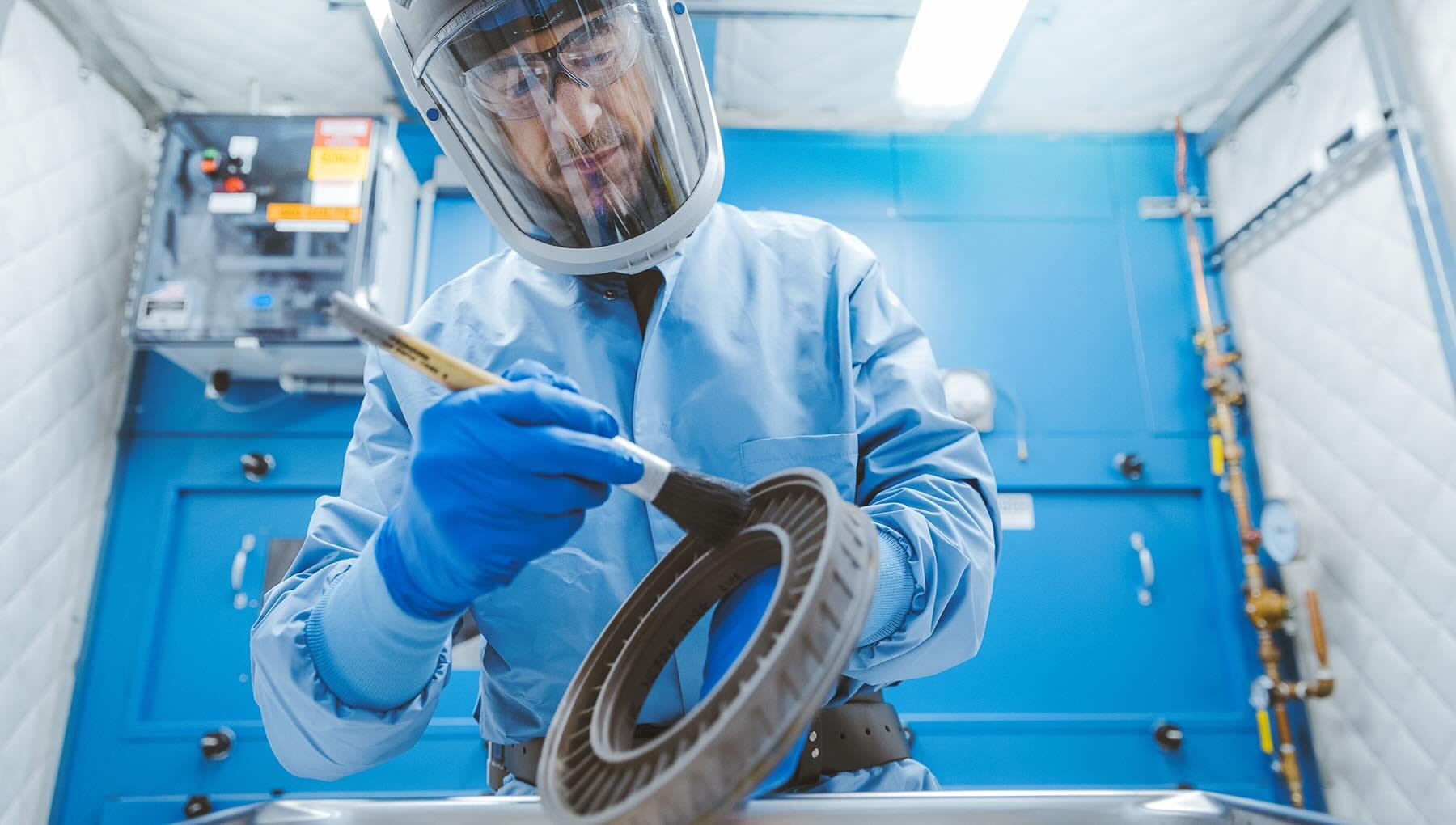
The table lists materials offered on Colibrium machines as of October 2026, plus metals mainly seen in research.
| Material | Typical use | Notes |
|---|---|---|
| Ti-6Al-4V Grade 5 | Aerospace brackets, implants | The main EBM alloy; offered on Spectra H, L and M |
| Ti-6Al-4V Grade 23 (ELI) | Orthopaedic implants | Fewer impurities for better toughness and fatigue life; Spectra L and M |
| Titanium aluminide (TiAl) | Low-pressure turbine blades | Brittle; EBM's hot bed avoids cracking; Spectra H |
| Nickel alloy 718 | Hot-section aerospace and energy parts | Spectra H |
| Cobalt-chrome (CoCr) | Implants, wear parts | Spectra H |
| Highly alloyed tool steel | Tooling inserts, wear parts | Spectra H |
| Copper, tantalum, tungsten | Heat sinks, implants, radiation shielding | Mainly research or other vendors' systems |
Aluminium is a poor fit. Its alloying elements, such as magnesium and zinc, tend to boil off in a hot vacuum. Non-conductive materials such as polymers and most ceramics cannot drain the charge, so they are ruled out.
What is electron beam melting used for?
EBM is used mainly where titanium or crack-prone superalloys must be printed in volume with low residual stress. Its two signature markets are orthopaedic implants, such as porous titanium hip cups, and aerospace turbine blades made from titanium aluminide, with smaller uses in space, energy and tooling.
Orthopaedic implants
EBM suits porous titanium implants. It can print lattice structures that mimic spongy bone, which helps bone grow into the implant, on top of a solid body in one build. Italian implant maker Lima Corporate introduced its first EBM-printed acetabular cup (the socket half of a hip replacement), the Delta TT, in 2007, according to Lima's own ten-year announcement.
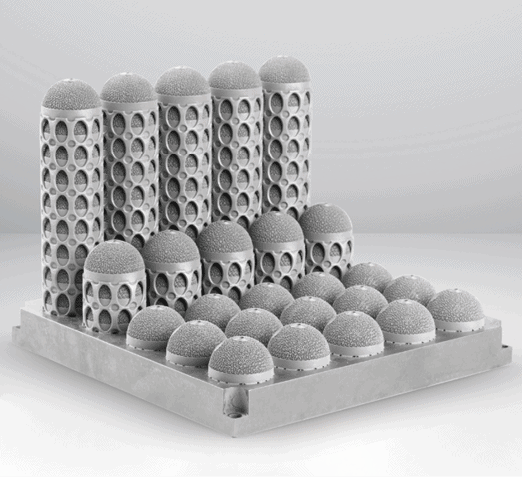
Three features make EBM a good fit here:
- Parts stack in 3D. The sintered powder cake holds parts in place and few supports are needed, so one build can hold many cups.
- The vacuum keeps titanium clean.
- The rough surface helps. On bone-contact faces, roughness aids grip.
Aerospace turbine blades
The best-known aerospace case is the GE9X engine for Boeing's 777X. Its low-pressure turbine blades are printed from titanium aluminide, which weighs about half as much as the nickel alloys it replaces. In June 2019, GE announced 27 more Arcam EBM machines (17 A2X and 10 Spectra H) for GE9X blade production.
Those machines joined 35 already running at Avio Aero in Cameri, Italy. An A2X builds six blades per batch; a Spectra H builds up to ten in about the same time.
TiAl is brittle at room temperature and cracks under the sharp temperature swings of laser processing. EBM's hot bed is what makes series production of these blades possible.
Other applications
- Space and defence: titanium brackets, housings and propellant system parts.
- Energy: nickel-alloy parts for gas turbines.
- Tooling: wear-resistant tool steel inserts.
- Research: refractory metals and new alloys that are hard to process with lasers.
How does electron beam melting compare with selective laser melting?
Both fuse metal powder in a bed, but EBM uses an electron beam in a hot vacuum, while selective laser melting uses lasers in inert gas on a cooler bed. EBM wins on low stress and titanium batch output. Laser PBF wins on detail, surface finish and material choice.
Selective laser melting (SLM), more correctly called laser powder bed fusion (L-PBF), is EBM's closest rival. The table compares them as of October 2026.
| Factor | Electron beam melting (EBM) | Laser powder bed fusion (SLM/DMLS) |
|---|---|---|
| Energy source | Electron beam, 3–6 kW | One or more fibre lasers, typically 200 W–1 kW each |
| Beam steering | Magnetic coils, no moving parts | Galvanometer mirrors |
| Atmosphere | Vacuum with helium bleed | Argon or nitrogen |
| Bed temperature | 600–1,100 °C | Near room temperature to about 200 °C |
| Layer thickness | Usually 50–100 µm | Usually 20–50 µm |
| Residual stress | Very low; stress relief often not needed | High; stress relief usually needed |
| Supports | Few, mainly to carry heat away | Many, to anchor parts and resist warping |
| Part stacking | Yes, parts nest in 3D | Limited; parts sit on the plate |
| Detail and surface | Coarser and rougher | Finer features, smoother surfaces |
| Material range | Narrow; conductive metals, mostly titanium | Broad: steels, aluminium, titanium, nickel, copper |
| Powder removal | Sintered cake; needs blasting | Loose powder; easier to clear |
Choose EBM when you are printing titanium or TiAl in batches, cracking or residual stress is your main risk, and you will machine the working surfaces anyway.
Choose laser PBF when you need fine features, thin walls, smooth internal channels, aluminium, or a wider choice of service providers.
If you are also weighing binder jetting or wire arc printing, our comparison of DMLS vs binder jetting vs WAAM covers those trade-offs.
What are the advantages and disadvantages of electron beam melting?
EBM's main strengths are low residual stress, the ability to print crack-prone alloys and high titanium output from nested builds. Its main weaknesses are rough surfaces, coarse detail, a short material list, hard-to-clear powder cake and scarce machine capacity, especially in India.
Advantages
- Low residual stress. The hot bed means parts rarely warp, and many skip a separate stress-relief cycle.
- Crack-prone alloys become printable. TiAl and some nickel superalloys that crack in laser machines build reliably.
- High titanium output. High beam power, thick layers and 3D nesting give strong batch throughput.
- Clean chemistry. The vacuum protects reactive metals from oxygen and nitrogen.
- Fewer supports. Less support means less removal work and less wasted powder.
- Reusable powder. Unmelted powder is recovered, sieved and reused.
Disadvantages
- Lower resolution. Coarse powder and thick layers limit fine features and thin walls.
- Rough surfaces. Most working surfaces need machining or other finishing.
- Short material list. Only conductive metals, and commercially mostly titanium, TiAl, nickel 718 and CoCr.
- Powder cake removal. Sintered powder must be blasted out, which is hard in small internal channels.
- Long cool-down. Builds cool for hours before you can open the chamber.
- High cost, few suppliers. The vacuum system and electron gun make machines expensive, and far fewer service bureaus offer EBM than laser PBF.
- X-ray hazard. An electron beam hitting metal gives off X-rays, so the chamber is shielded. Follow the machine maker's safety manual for operation and maintenance.
Who makes electron beam melting machines?
Colibrium Additive, formerly Arcam and GE Additive, is the best-known supplier. Its current EBM line is the Spectra H, Spectra L, Spectra M and Q10plus. A small group of newer makers in Sweden, the UK, Germany, Japan and China also build EB-PBF systems.
Colibrium launched its entry-level Spectra M on 25 June 2024. It has a Ø270 × 430 mm build volume and a 4.5 kW beam, and is aimed at implant makers looking for lower cost per part.
Other EB-PBF suppliers include the following:
| Company | Country | Example system |
|---|---|---|
| Freemelt | Sweden | Freemelt ONE (open research platform) |
| Wayland Additive | UK | Calibur3 |
| pro-beam | Germany | PM EBM series |
| JEOL | Japan | JAM-5200EBM |
| Xi'an Sailong Metal | China | T200 |
| QBeam | China | Qbeam S200 |
In India, EBM capacity is thin. Chennai-based Primaeam listed EBM among the technologies at the AM centre it opened in Chennai, aimed largely at healthcare. Check current capacity, qualified alloys and lead times directly with any supplier before you design around EBM.
When is electron beam melting the wrong choice?
EBM is the wrong choice when your part is small and detailed, or made from aluminium or alloys it does not offer. It also fails with long internal channels or batches too small to fill a build. In those cases, laser PBF, binder jetting or CNC machining usually works better.
Work through these checks before you specify EBM:
- Is the material titanium, TiAl, nickel 718 or CoCr? If not, EBM is probably off the table.
- What is the smallest feature? Thin walls, small holes and fine lattices usually print better with laser PBF.
- Which surfaces are functional? Budget for machining every sealing face, bearing seat and thread.
- Are there internal channels? Sintered powder is very hard to clear from long or narrow passages.
- What is the batch size? EBM's cost per part drops sharply when you fill the build volume with nested parts. One or two parts rarely justify it.
- Can you find a supplier? EBM capacity is scarce outside Europe and North America. Check lead times and qualification before you commit a design.
Match the process to the part, not to the headline. When I started making prototypes, I chose a printer mainly on price instead of matching the technology to my needs. That cost me many hours trying to get precise results from a machine never designed for them. Picking EBM for a small, finely detailed part is the same trap at a much higher price.
How should you start an EBM project?
Start with one real part, not a machine. Pick a titanium or TiAl component where residual stress, cracking or batch output is the real problem. Get an EBM quote and a laser PBF quote for the same drawing, including machining, then compare cost, lead time and test results.
Treat the first build as a learning run. Ask the supplier which parameter set they will use, what machining stock they recommend and how they will clear powder from any internal features. For fatigue-critical parts, ask how they handle post-build heat treatment and inspection.
Earlier this year, a medical device startup in Bengaluru asked me whether to book EBM time for its first titanium spinal cage prototypes. The design was still changing every few weeks, and EBM slots in India were hard to find. We printed the early versions on a laser PBF service instead and kept EBM in the plan for the porous production design. The team finished three design rounds in the time one EBM slot would have taken.
If you want the bigger picture on how powder-based metal processes differ, our explainer on how binder jetting works is a useful next read.
FAQs: Electron Beam Melting
What is the difference between electron beam melting and electron beam welding?
Electron beam welding joins two existing metal parts by melting a narrow seam with an electron beam, usually in a vacuum. Electron beam melting (EBM) uses the same kind of beam to build a new part from metal powder, one layer at a time. The physics is similar, but electron beam welding joins parts while EBM is an additive manufacturing process.
Do electron beam melting parts need heat treatment?
Electron beam melting (EBM) parts usually need less heat treatment than laser-printed parts, because the hot powder bed keeps residual stress low and a separate stress-relief cycle is often skipped. For fatigue-critical titanium parts such as implants and aerospace brackets, many makers still use hot isostatic pressing (HIP) to close tiny internal pores. Your part's specification and customer approval decide whether HIP is required.
Is electron beam melting available in India?
Electron beam melting capacity in India is limited compared with laser powder bed fusion. A few service providers and research centres run electron beam machines, mostly for titanium medical work. If your part needs EBM, confirm the machine model, qualified alloys, inspection options and lead time with the supplier first. Get a laser powder bed fusion quote as a backup.
How should you design a part for electron beam melting?
Design an electron beam melting part with machining stock on every working surface, because as-built faces are rough. Avoid long, narrow internal channels that trap sintered powder, and add escape holes for powder in hollow sections. Orient and nest parts so the build volume is full, since EBM cost per part falls sharply with fuller builds. Ask the supplier for their minimum wall and hole sizes.
Why does electron beam melting use helium during the build?
Electron beam melting (EBM) machines bleed a small amount of helium into the vacuum chamber during the build. The helium helps keep the beam stable and reduces charge build-up in the powder. After the last layer, helium is often added to speed up cooling, because heat leaves a hot part very slowly in a pure vacuum. The gas pressure stays far below normal air pressure throughout.


Discussion