



Massachusetts Institute of Technology (MIT) researchers, in collaboration with Princeton University and the Gwangju Institute of Science and Technology, have developed an AI 3D printing preview tool called VisiPrint that generates appearance-first renderings of objects before fabrication. The system aims to address material waste caused by repeated reprints when the final object's colour, texture, or finish does not match a user's expectations.
Studies estimate that as much as a third of material used in 3D printing ends up in landfill, largely from discarded prototypes. VisiPrint targets this inefficiency by allowing users to visualise how a printed object will look using just two inputs: a screenshot of the digital design from slicer software and a single image of the intended print material.
AI 3D Printing Preview Tool Explained
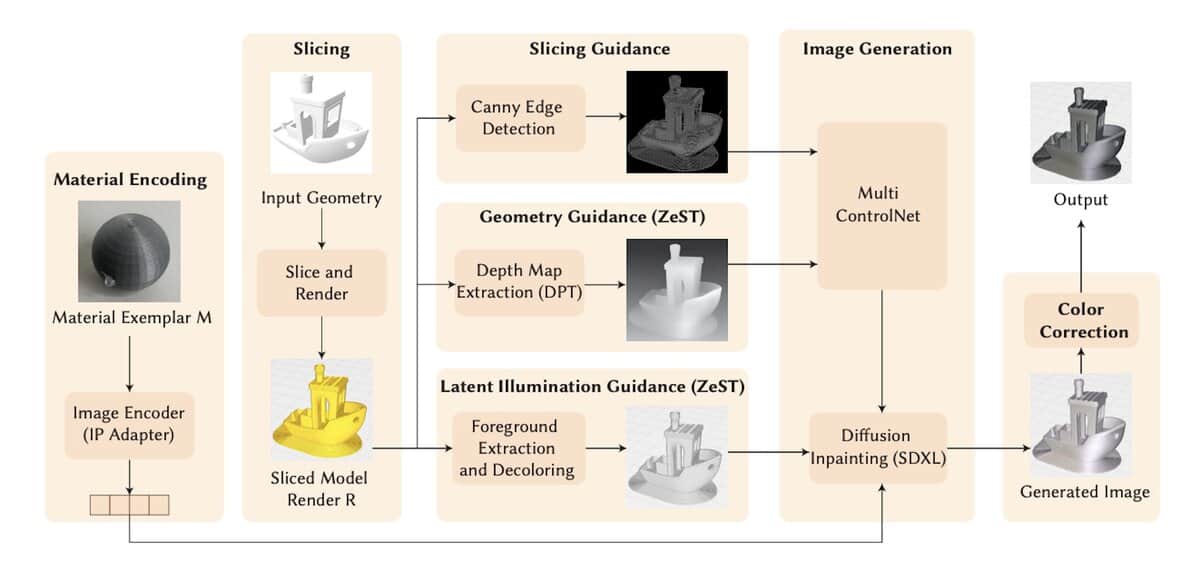
VisiPrint was built around fused deposition modelling (FDM), the most widely used 3D printing method, in which filament is melted and extruded through a nozzle to build objects layer by layer. The system employs two AI models working in tandem. A computer vision model extracts appearance-relevant features from the material sample, including colour, gloss, and translucency, and feeds them to a generative AI model that computes the object's geometry while incorporating the nozzle's slicing path.
A special conditioning method ensures the preview reflects the constraints of the fabrication process. The approach uses a depth map to preserve shape and shading, combined with an edge map that captures internal contours and structural boundaries. This material-aware rendering process accounts for how the melting and extrusion stages alter a material's appearance, something standard slicer previews do not address.
"If you don't have the right balance of these two things, you could end up with bad geometry or an incorrect slicing pattern. We had to be careful to combine them in the right way."
— Maxine Perroni-Scharf, EECS Graduate Student, MIT
User Study and Performance Results
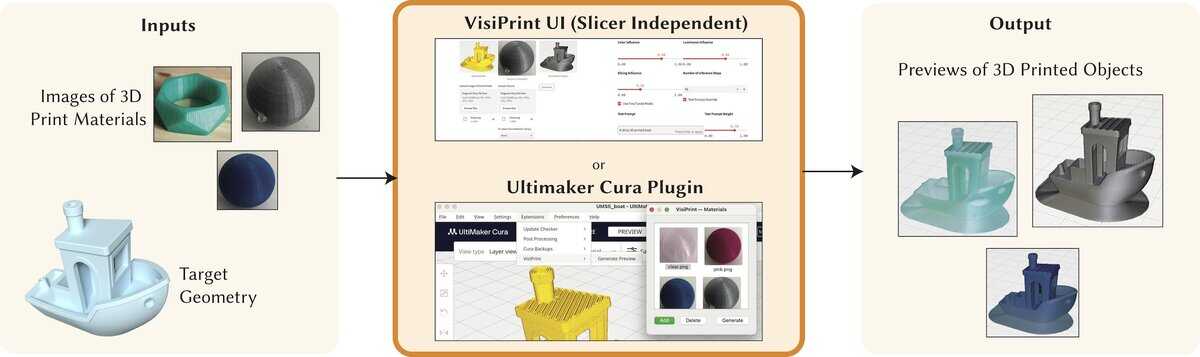
The researchers evaluated VisiPrint through a user study comparing it against existing tools. Nearly all participants rated VisiPrint as providing superior overall appearance and greater textural similarity to actual printed objects than competing methods. The preview process averaged approximately one minute, which was more than twice as fast as any alternative tested.
In a separate task-based evaluation, VisiPrint was also tested as both a standalone application (VisiPrint UI) compatible with any slicer software, and as a plugin for Ultimaker's Cura slicer. Within a set time limit, participants completed 100% of preview tasks using VisiPrint, compared with 63% using Cura and just 13% using Blender.
“3D printing can be a very wasteful process. Some studies estimate that as much as a third of the material used goes straight to the landfill, often from prototypes the user ends up discarding. To make 3D printing more sustainable, we want to reduce the number of tries it takes to get the prototype you want.”
— Maxine Perroni-Scharf, EECS Graduate Student, MIT
Applications and Broader Implications

The researchers identified potential applications in dentistry, where accurate colour matching for temporary crowns and bridges is critical, and in architecture, where visual assessment of scale models aids design decisions. The AI 3D printing preview tool is intended to complement rather than replace functional previews from slicer software; VisiPrint does not estimate printability, mechanical feasibility, or likelihood of failure.
Patrick Baudisch, Professor of Computer Science at the Hasso Plattner Institute, who was not involved in the research, notes that bringing a 'what you see is what you get' approach to 3D printing is long overdue, describing VisiPrint as a meaningful step in that direction.
Future Plans and Waste Reduction
The team plans to address visual artefacts that can occur when previews involve extremely fine details, and to expand the tool's capabilities to optimise parts of the printing process beyond material colour. The research, which was funded in part by an MIT Morningside Academy for Design Fellowship and an MIT MathWorks Fellowship, will be presented at the ACM CHI Conference on Human Factors in Computing Systems 2026.
As AI-powered tools become more embedded in digital fabrication workflows, systems like VisiPrint signal a broader shift toward bridging the gap between virtual models and physical output: with 3D printing waste reduction as an increasingly measurable outcome. The AI 3D printing preview tool represents an area of active research likely to see continued development as sustainability pressures on additive manufacturing intensify.


