



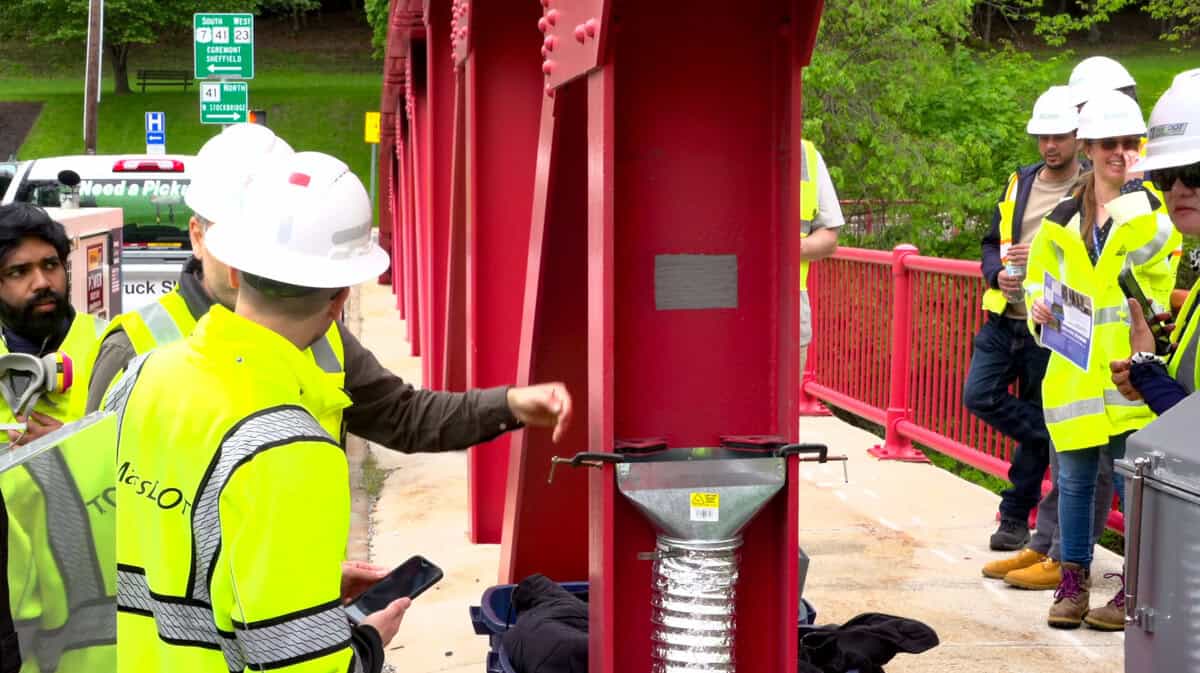
UMass Amherst, a public research university in Amherst, Massachusetts, United States, researchers have successfully demonstrated ground-breaking cold spray 3D printing to repair America's deteriorating bridge infrastructure. The University of Massachusetts Amherst, in collaboration with the Massachusetts Institute of Technology (MIT), conducted a first-of-its-kind proof-of-concept demonstration using cold spray additive manufacturing on Great Barrington's former "Brown Bridge" in Western Massachusetts. This pioneering approach represents a significant breakthrough in addressing the nation's critical infrastructure challenges whilst minimising disruption to traffic flow.
The cold spray technique involves spraying high-velocity metal powder particles to coat bridge beams, creating multiple layers that restore structural properties. Whilst this technology has proven effective for submarines, aeroplanes, and ships, this marks the first application to bridge infrastructure. The demonstration on the red bridge built in 1949 provides a pathway to faster, more cost-effective repair solutions.
Cold Spray 3D Printing to Repair Bridge Infrastructure
America faces an unprecedented infrastructure crisis, with 49% of the nation's bridges in "fair" condition and 6.8% rated "poor," according to the 2025 Report Card for America's Infrastructure. The projected restoration cost exceeds $191 billion. Massachusetts has roughly 9% of its 5,295 bridges structurally deficient, with repair needs far outpacing available funding.
"Any time you drive, you go under or over a corroded bridge. They are everywhere. It's impossible to avoid, and their condition often shows significant deterioration."
- Simos Gerasimidis, associate professor of civil and environmental engineering at UMass Amherst and principal investigator
The cold spray 3D printing methodology offers distinct advantages over traditional repair techniques. "Every time you do repairs on a bridge you have to block traffic for substantial amounts of time," Gerasimidis explained. "This will allow us to [apply the technique] on this actual bridge while cars are going [across]." This capability eliminates economic and social costs associated with extended bridge closures.
The research team developed sophisticated 3D LiDAR scanning methods to replace time-consuming visual assessments. This enables precise corrosion identification and targeted material deposition. "By combining scanning with precise material deposition, we can be very targeted and say, 'we're going to print here and here and here and we're going to give this bridge another 10 years of life,' which is huge," Gerasimidis explains.
Collaborative Research Framework Drives 3D Printing Innovation

The project's success stems from collaboration between academic institutions and government agencies, including the Massachusetts Department of Transportation (MassDOT), the Massachusetts Technology Collaborative (MassTech), the U.S. Department of Transportation, and the Federal Highway Administration.
Gerasimidis and his team have studied bridge deterioration for a decade, working with various state DOTs. "We know this problem quite well," he says. "We have seen thousands of inspection reports, we have gone to bridges. We have tested many beams in our lab, so we know how these things behave and exactly where we need to repair."
The demonstration utilised the former "Brown Bridge," which crosses the Housatonic River at the intersection of state routes 7, 41, and 23. The bridge is scheduled for demolition in a few years, providing an ideal testing opportunity. After demolition, the UMass team will analyse the sprayed beams in their laboratory, measuring how successfully the deposited steel powder adhered to the structure under field conditions compared to controlled laboratory settings.
"This is a tremendous collaboration where cutting-edge technology is brought to address a critical need for infrastructure in the commonwealth and across the United States. I think we're just at the beginning of a digital transformation of bridge inspection, repair and maintenance."
- John Hart, Class of 1922 Professor in the Department of Mechanical Engineering at MIT
MassDOT has served as a valued research partner, with Gerasimidis crediting their forward-thinking approach. "It's a very Massachusetts success story," he noted. "It involves MassDOT being open-minded to new ideas. It involves UMass and MIT putting [together] the brains to do it."
"Now that we've completed this proof-of-concept repair, we see a clear path to a solution that is much faster, less costly, easier, and less invasive," said Gerasimidis. "To our knowledge, this is a first. Of course, there is some R&D that needs to be developed, but this is a huge milestone."


