



AAKA Space Studio, an Ahmedabad-based space architecture startup, has developed and tested a 3D-printed Mars radiation shield during an analog space mission, as reported in an India Today coverage. The demonstration highlights how In-Situ Resource Utilisation (ISRU) could reduce reliance on Earth-supplied payloads for future Mars missions.
Conventionally, radiation shielding requires transporting dense materials from Earth, significantly increasing payload mass and mission costs. The development addresses this challenge in an environment where Mars offers minimal natural protection from cosmic radiation.
What Is 3D-Printed Mars Radiation Shield
A 3D-printed Mars radiation shield is a regolith-based structure designed to protect astronauts from cosmic radiation while maintaining thermal stability in Mars habitats. It is constructed using locally sourced materials, such as Martian soil or its Earth-based simulants, through additive manufacturing processes.
In this case, the shield was fabricated using Martian soil simulants engineered from Indian geological materials. The structure is monolithic, combining radiation protection, structural integrity, and thermal resistance (three essential requirements for long-duration habitation).
ISRU Materials for Mars Construction
At the core of this innovation is In-Situ Resource Utilisation (ISRU), a concept that focuses on using materials already available on celestial bodies. Transporting construction materials from Earth remains prohibitively expensive, making ISRU a key enabler for scalable space infrastructure.
To replicate Martian conditions, AAKA Space Studio sourced olivine-rich materials from ultramafic complexes in Salem, Tamil Nadu, and combined them with limestone analogues from the Ariyalur basin. These were paired with specially engineered lime-based binders designed to mimic cement behaviour under Martian conditions.
The resulting material mix enabled the creation of high-fidelity regolith simulants suitable for construction testing on Earth.
3D Printing Process and Collaboration
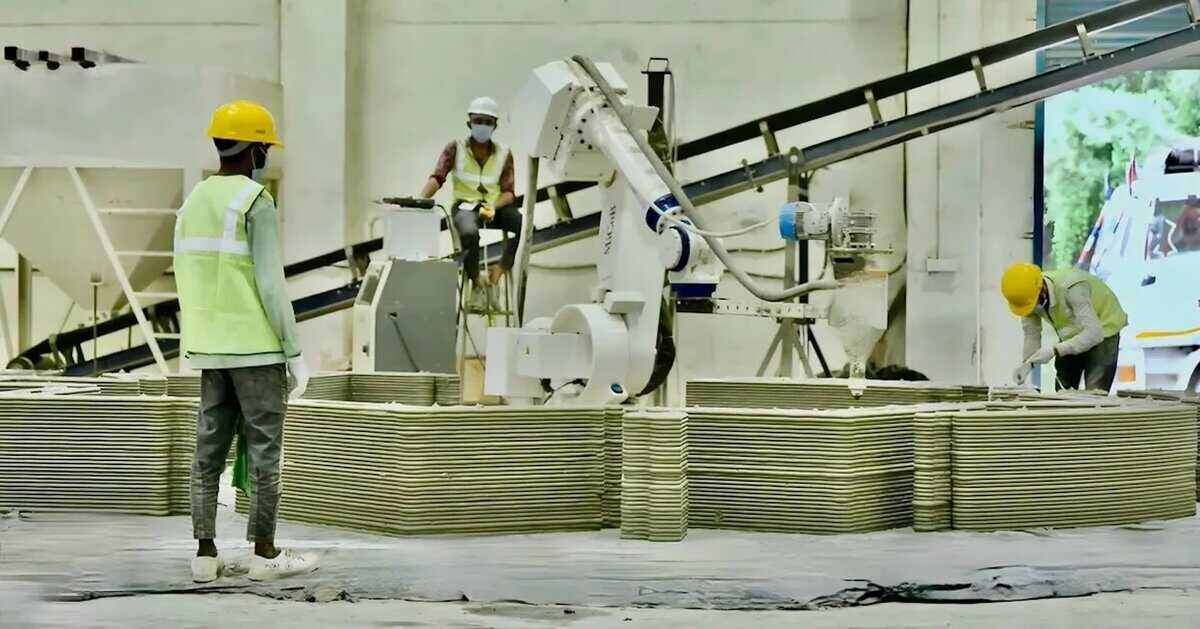
The project was executed in collaboration with MiCoB, which supplied its MiCO-V 3D concrete printing systems, and academic partners including a Government Arts College. The system integrates robotic and gantry-based additive manufacturing techniques to produce structures layer by layer.
This approach allows for autonomous construction, reducing the need for human intervention (an important consideration for off-world environments). The process involves controlled material extrusion, curing, and structural consolidation to create dense, radiation-resistant forms.
The resulting 3D-printed Mars radiation shield demonstrated the feasibility of using regolith-based materials in combination with automated construction systems to build functional habitat components.
Radiation Shield Testing and Performance
The shield was tested during a large-scale analog space mission designed to simulate extraterrestrial conditions. According to the development team, the structure provides protection against harmful cosmic radiation while also maintaining thermal stability (both essential for sustaining human life on Mars).
Mars lacks a strong magnetic field and dense atmosphere, exposing astronauts to significant radiation risks, including long-term cellular damage. Traditional shielding methods rely on transporting heavy materials from Earth, which significantly increases mission costs and payload constraints, as also seen in efforts to test 3D printed material performance on Moon.
By contrast, ISRU-enabled construction using a 3D-printed Mars radiation shield offers a pathway to reduce launch mass while enabling scalable habitat development.
India’s Role in Space Manufacturing
The project underscores the growing role of Indian startups in space architecture, materials science, and advanced manufacturing, alongside developments such as single-piece 3D printed rocket engines by Agnikul Cosmos.
The collaboration reflects increasing convergence between construction-scale 3D printing and aerospace applications, particularly in the context of lunar and Martian missions.
As international space agencies and private players accelerate plans for long-duration missions, solutions based on ISRU and additive manufacturing are expected to play a central role. The 3D-printed Mars radiation shield developed by AAKA Space Studio represents an early demonstration of how such systems could be deployed in future extraterrestrial environments.


