



Agnikul Cosmos, the Chennai-based private space transportation startup incubated at IIT Madras, has successfully test-fired its Agnikul Agnite engine, a fully 3D-printed, single-piece Inconel rocket engine measuring one metre in length. The test, completed at the company's in-house large-format additive manufacturing (LFAM) facility in Chennai, marks the largest single-piece 3D printed rocket engine ever built and the first of its scale to be tested with electric motor-driven pumps.
Unlike conventional rocket engines that require up to seven months of machining, welding, and multi-component assembly, the Agnikul Agnite engine can be fully 3D printed in just seven days, at roughly one-tenth the cost of traditional manufacturing, according to the company. The engine runs from fuel inlet to exhaust as an integrated structure, with no welds, joints, or fasteners. Agnikul holds a US patent for the design.
What Is the Agnikul Agnite Engine?
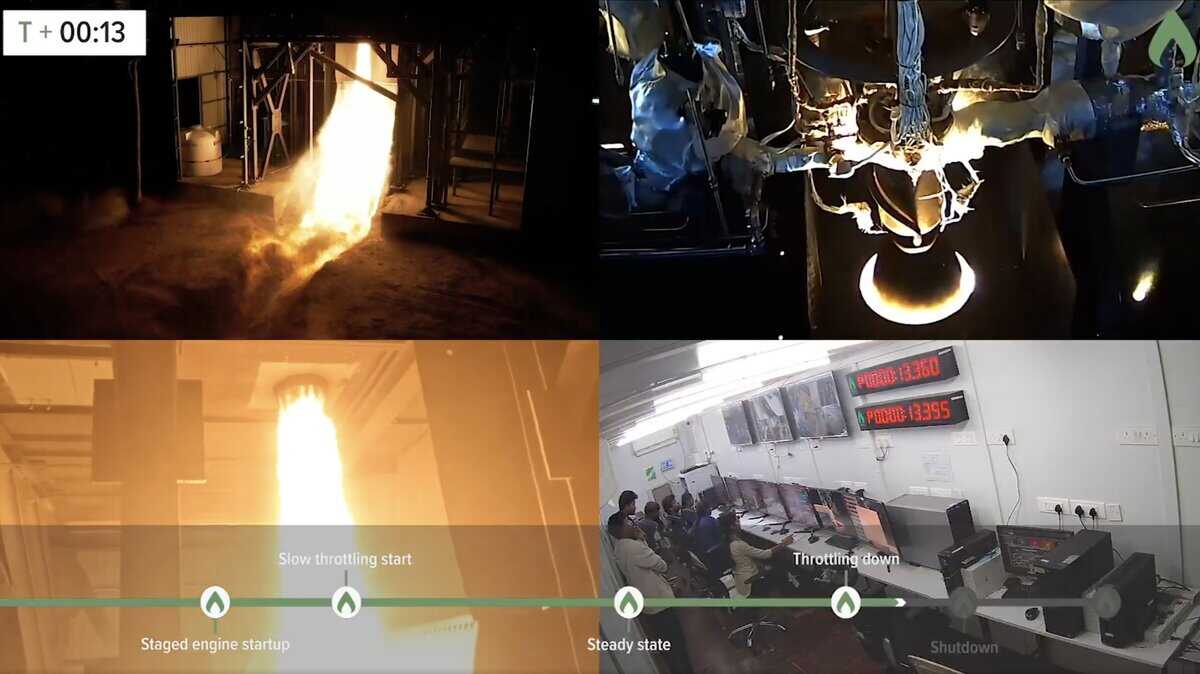
The Agnikul Agnite engine is a semi-cryogenic, single-piece Inconel rocket engine that powers the booster stage of Agnikul's Agnibaan launch vehicle. Built entirely through additive manufacturing, the engine eliminates the dozens of individually machined and assembled components found in traditional propulsion systems. Its electric pump architecture replaces conventional gas-generator systems, reducing the number of moving parts and simplifying refurbishment between flights, a design choice directly tied to the company's reusability roadmap.
"We chose single-piece Inconel construction and electric pump architecture specifically to solve our customers' scheduling problems and enhance automation of engine manufacturing. Traditional engines take months to build because you're machining, welding, and assembling dozens of parts. Ours prints in a few days, which means we can respond to launch demand faster than the industry standard."
— Srinath Ravichandran, Co-founder and CEO, Agnikul Cosmos
Ravichandran adds that the electric pump rocket engine design carries fewer parts to refurbish between flights, which is central to Agnikul's goal of building responsive and cost-efficient launch systems.
From Seven Months to Seven Days
The speed of production enabled by the Agnikul Agnite engine translates directly into faster launch responsiveness. For satellite operators in sectors such as defence and disaster response, where launch timelines are closely tied to operational outcomes, the company's offering enables planning around committed launch windows, precise satellite placement, and the flexibility to accommodate payload changes up to 30 days before flight.
The tested engine was printed, depowdered, and post-processed entirely within the LFAM facility that Agnikul commissioned towards the end of 2025. Combined with its in-house mission control, dedicated ground stations, and flight-proven propulsion systems, the company now operates a vertically integrated launch ecosystem, providing a single point of contact from contract signature through on-orbit checkout.
"This engine test validates that our propulsion systems are ready to operate at the scale required for multiple launches per quarter. With propulsion now largely de-risked, our focus is firmly on execution and demonstrating consistent launch cadence and mission reliability."
— Moin SPM, Co-founder and COO, Agnikul Cosmos
Impact on Global Space Industry
The test builds on a series of recent milestones. Last month, Agnikul fired three semi-cryogenic engines simultaneously in synchronisation, the first such test conducted in India. Both achievements build on the foundation laid by the 2024 Agnibaan SOrTeD mission, India's first controlled flight from a private launchpad at Sriharikota and the country's first flight powered by a semi-cryogenic engine.
Among private space startups in India, Agnikul's approach to single-piece additive manufacturing places it in a distinct position. Globally, the method has parallels: LEAP 71 and HBD recently produced the XRA-2E5, a 200 kN aerospike engine also built as a single-piece Inconel print, demonstrating that the manufacturing approach is repeatable at this scale.
The company is now valued at over US $500 million following a funding round that included participation from HDFC Bank, Advenza Global Limited, and Artha Select Fund, among others. Separately, TIDCO, the Tamil Nadu government's industrial development arm, invested ₹25 crore in Agnikul under the TIDCO Startup Investment Policy 2025, marking the first government equity investment in an Indian space startup.
With the Agnikul Agnite engine now validated at booster scale and a growing portfolio of patents across the United States, Europe, and India, the company's near-term trajectory centres on translating manufacturing speed into consistent launch cadence for small satellite operators, a segment experiencing rising global demand.


