



EPFL (Ecole Polytechnique Federale de Lausanne), the Swiss federal institute of technology, has developed a holographic volumetric 3D printing platform that is 70 times more efficient than previous systems. The innovation enables the rapid fabrication of tissue-like structures embedded with living cells at scales suitable for biomedical applications, with the findings published in Light: Science & Applications.
The platform builds on tomographic volumetric additive manufacturing (TVAM), a method that uses laser light to solidify photosensitive resin inside a rotating vial rather than building objects layer by layer. Where earlier TVAM systems relied on digital micromirror devices (DMDs) that blocked or redirected most incoming laser energy, the EPFL team's Laboratory of Applied Photonic Devices (LAPD) has introduced a phase light modulator (PLM) that directly controls the phase of the light beam, achieving roughly 24% absolute optical efficiency compared with single-digit percentages in conventional setups.
How Holographic Volumetric 3D Printing Works
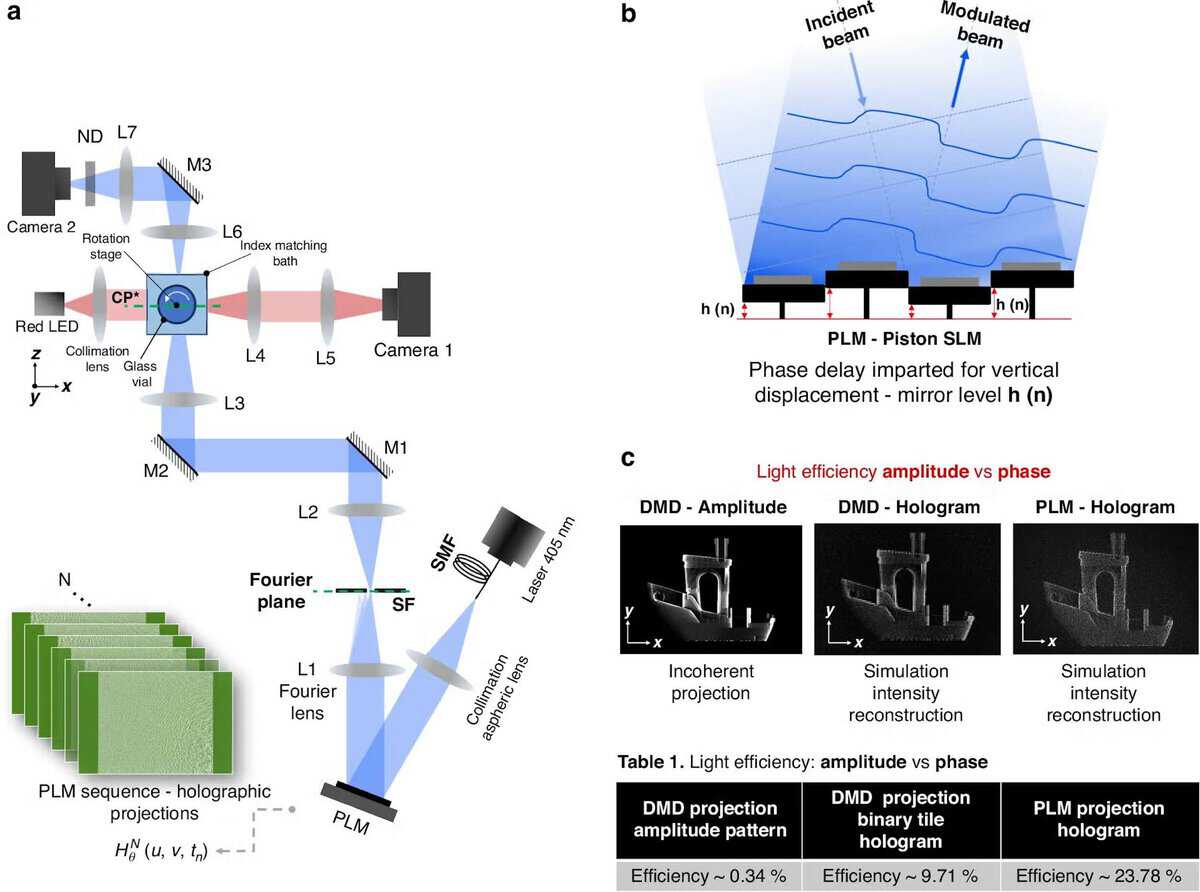
The PLM uses microscopic piston-like mirrors that shift vertically in precise increments, altering how reflected light waves align. This enables the projection of detailed holographic patterns into the resin, directing far more laser power toward the printing process than DMD-based approaches. The system also employs self-healing Bessel beams, which maintain focus across longer distances and reconstruct themselves after encountering scattering from particles or cells, a critical advantage when printing in biological media.
In experiments, the researchers solidified millimetre-scale objects within seconds and centimetre-scale objects within minutes using only low-power laser sources. A fusilli-shaped structure printed in 32 seconds at 18 milliwatts, whilst a Stanford Bunny model printed in just over one minute at 50 milliwatts. EPFL has previously demonstrated rapid volumetric fabrication using light-based approaches, but the new platform represents a substantial leap in both efficiency and biocompatibility.
"Our method's demonstrated efficiency and precision finally makes it possible to bioprint tissue-like structures at near-clinical scale. We have printed structures substantially larger than those achieved with previous holographic approaches, despite increased light scattering caused by the embedded cells."
— Christophe Moser, Head of the Laboratory of Applied Photonic Devices, EPFL
Bioprinting With Embedded Living Cells
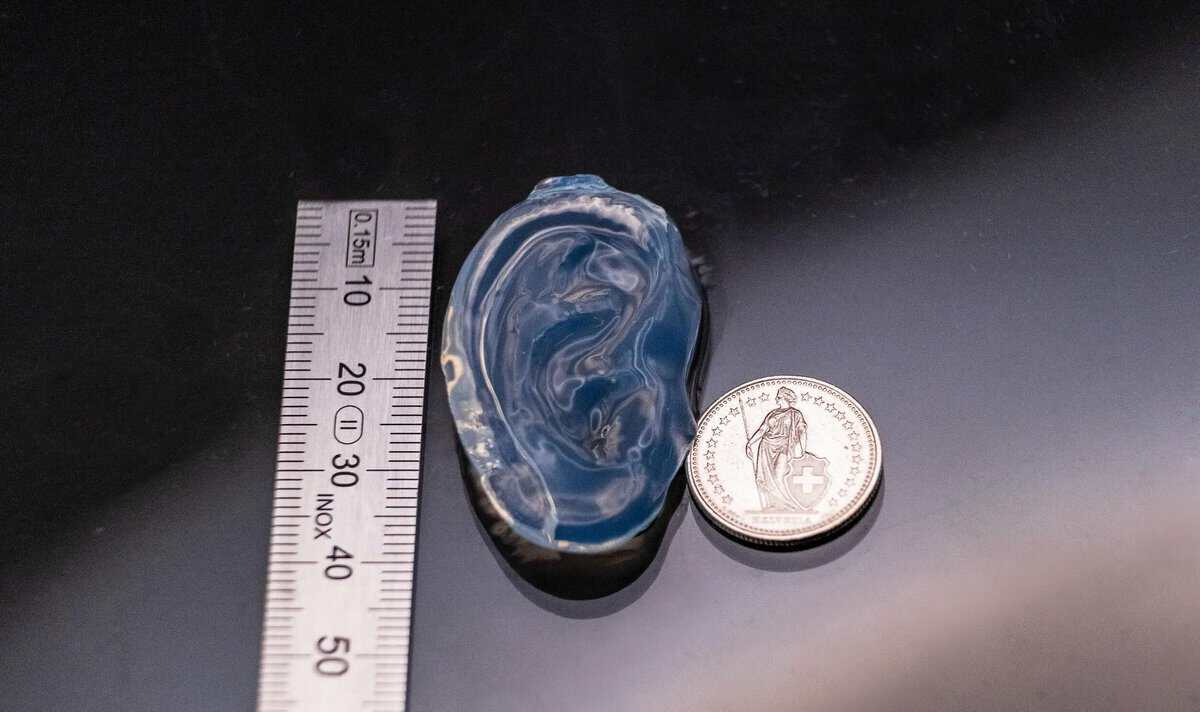
The team's most significant demonstration involved printing a life-sized human ear using a 150-milliwatt laser diode in a gelatin-based resin, a step toward 3D-printed implants for reconstructive medicine. In a separate 3D bioprinting test, the researchers printed a smaller construct, the researchers printed a smaller construct of 64 cubic millimetres containing human fibroblast cells at a density of one million cells per millilitre. Confocal microscopy performed six days later confirmed the embedded cells remained viable and had formed organised networks throughout the structure.
To address surface quality challenges in holographic volumetric 3D printing, the researchers developed a time-multiplexing strategy to reduce speckle (grainy interference patterns caused by laser light that can leave rough surfaces on printed objects). By rapidly projecting multiple slightly shifted holograms in sequence, the interference patterns average out, yielding smoother and more detailed structures.
"Our approach brings volumetric printing closer to real-scale implants, and biologically compatible manufacturing using low-power laser sources."
— Maria Alvarez-Castaño, Lead Author and PhD Student, LAPD, EPFL
Future of Volumetric Bioprinting
The LAPD team has outlined several areas for continued development, including enhancing projection fidelity and studying the limits of beam shaping when printing in bioresins with high cell densities. Forthcoming publications will describe methods for printing directly onto or around existing objects, as well as new techniques for shaping microscopic details by predicting how chemicals react within the resin during the printing process.
One future approach aims to eliminate the need for vial rotation entirely, fabricating objects simply by projecting a hologram onto a stationary vial of resin. Such developments could further simplify holographic volumetric 3D printing platforms for clinical and industrial adoption.


