



Stratasys, a leader in polymer additive manufacturing solutions, has entered into a definitive agreement to complete the Stratasys Markforged acquisition in an all-cash transaction valued at US $42.5 million. The deal will see Stratasys absorb Markforged's Fused Filament Fabrication (FFF) hardware, continuous carbon fibre materials, and The Digital Forge software platform from parent company Nano Dimension. The transaction is expected to close in the second half of 2026, subject to customary closing conditions and regulatory approvals.
Behind the Stratasys Markforged Acquisition

Markforged generated approximately US $70 million in revenue in 2025, though this figure includes its Metal Binder Jetting product line, which Nano Dimension will retain. The acquisition covers Markforged's polymer, composite, and metal extrusion portfolio, along with its integrated Digital Forge platform (a system combining hardware, in-house materials, and secure software for simulation, part management, and automated print optimisation).
Stratasys expects the deal to be accretive to gross margins and to deliver meaningful cost synergies, along with positive EBITDA contribution, within the first year following close. The company intends to update its financial guidance after the transaction is completed.
"This acquisition further advances our capabilities to meet customers' growing needs in critical areas such as defence and aerospace at a time when additive manufacturing continues to displace traditional manufacturing for high-requirement applications in production."
— Dr. Yoav Zeif, Chief Executive Officer, Stratasys
Continuous Carbon Fibre Capabilities
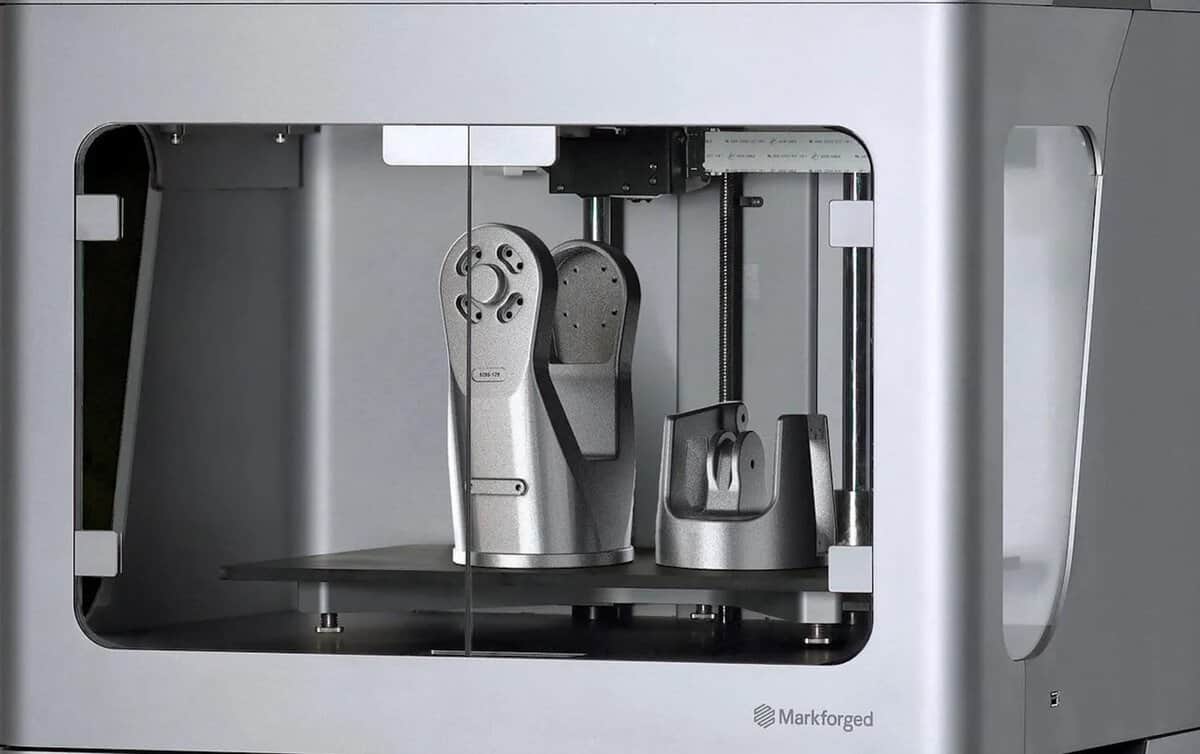
Traditional FFF 3D printing produces parts from standard thermoplastics, which often lack the mechanical strength required for demanding aerospace, defence, and automotive applications. Markforged's continuous carbon fibre reinforcement technology addresses this limitation by embedding continuous strands of carbon fibre within 3D-printed parts, producing components that are significantly lighter and stronger than conventional FFF alternatives.
This composite capability is expected to support aerospace and defence use cases across tooling, fixtures, ground support equipment, and select production parts. The addition complements Stratasys' existing composite 3D printers and builds on the company's earlier acquisition of Arevo's carbon fibre technology, signalling a sustained strategic push into high-performance composites. Markforged also brings a robust materials development process for high-performance polymer and metal filaments, further diversifying Stratasys' materials portfolio for end-use applications in food and beverage, automotive, and industrial manufacturing.
Nano Dimension's Strategic Exit
For Nano Dimension, the sale represents a significant step in its three-phase strategic plan. Phase 1 focuses on streamlining operations and reducing cash burn. Phase 2, under which this sale falls, targets the monetisation of product lines to simplify the business and strengthen the balance sheet. Phase 3 centres on evaluating strategic alternatives to maximise long-term shareholder value.
The transaction is expected to reduce Nano Dimension's annualised cash burn by approximately US $15 million through direct and indirect operating cost savings. Notably, Nano Dimension acquired Markforged just 13 months ago for US $116 million, making the US $42.5 million sale price a substantial markdown on its original investment.
"We are pleased to have reached an agreement with Stratasys that we believe positions MarkForged for continued growth and success under its ownership. This transaction represents a deliberate step in advancing Nano Dimension's three-phase strategic plan and accelerating Phase 3 execution."
— David Stehlin, Chief Executive Officer, Nano Dimension
Additive Manufacturing Consolidation Accelerates
The Stratasys Markforged acquisition is the latest in a series of consolidation moves reshaping the additive manufacturing sector. Following its acquisition of Nexa3D assets in 2025, Stratasys continues to pursue an aggressive inorganic growth strategy centred on broadening its multi-technology portfolio.
As the industry matures beyond its post-SPAC expansion phase, a period that has also seen investment firms acquire established AM companies, companies are increasingly pursuing integrated hardware-software-materials ecosystems rather than standalone product lines. The deal positions Stratasys to compete more effectively in regulated, performance-driven industrial settings where supply chain resilience, lightweight components, and manufacturing agility are essential requirements.
The transaction remains subject to regulatory approvals and customary closing conditions, with completion expected in H2 2026.


