



Anthropic, the AI safety company behind the Claude large language model, has brought Claude into CAD workflows as part of its broader Claude for Creative Work initiative, a move the 3D printing community is already calling Claude for CAD. The release introduces a set of connectors that link Claude directly to established design applications, including Autodesk Fusion and Blender, enabling users to create and modify 3D models through natural language prompts.
The connectors are built on Model Context Protocol (MCP), an open standard that governs how AI systems interact with external tools and services. Rather than replacing existing CAD workflows, the integrations position Claude as an interface layer that can translate plain-language instructions into structured design actions within the host application.
Conventional CAD modelling software typically requires users to navigate complex command structures, menu hierarchies, and scripting environments, a process that demands significant expertise and slows the path from concept to geometry.
Claude for CAD Meets Fusion
The Autodesk Fusion connector is the centrepiece of the announcement for the 3D printing community. Designers and engineers with a Fusion subscription can create and modify 3D models through direct conversation with Claude. Autodesk has released two separate MCPs: one action-oriented protocol for creating, modifying, and automating work on 3D models, and a second data-oriented protocol for searching, querying, and reusing design data across projects.
Specific capabilities include turning natural language into design actions, iterating on existing models without starting from scratch, automating repetitive modelling steps, and moving faster from concept to manufacturable output. Autodesk has emphasised that users retain control over what data is accessed and how it is used, with protections aligned to the company’s existing privacy and security standards.
“This is an early step in a broader shift toward a more open ecosystem where Autodesk software connects into the tools our customers already use.”
— Emily Scherbenski, Director of Cross Industry Audience Marketing at Autodesk
Blender Integration and Open-Source Access
The Blender connector takes a different approach, integrating directly with the open-source software’s Python API. This gives Claude a language-based interface to Blender’s scripting layer, allowing it to analyse complete scenes, detect errors, batch-assign materials, and write custom scripts that appear as tools within the Blender interface. Because the connector is built on MCP, it remains accessible to other language models beyond Claude, consistent with Blender’s open-source philosophy.
Anthropic has joined the Blender Development Fund as a Corporate Patron, contributing a minimum of €240,000 per year to support continued development of the Python API that underpins the integration.
Implications for 3D Printing Workflows
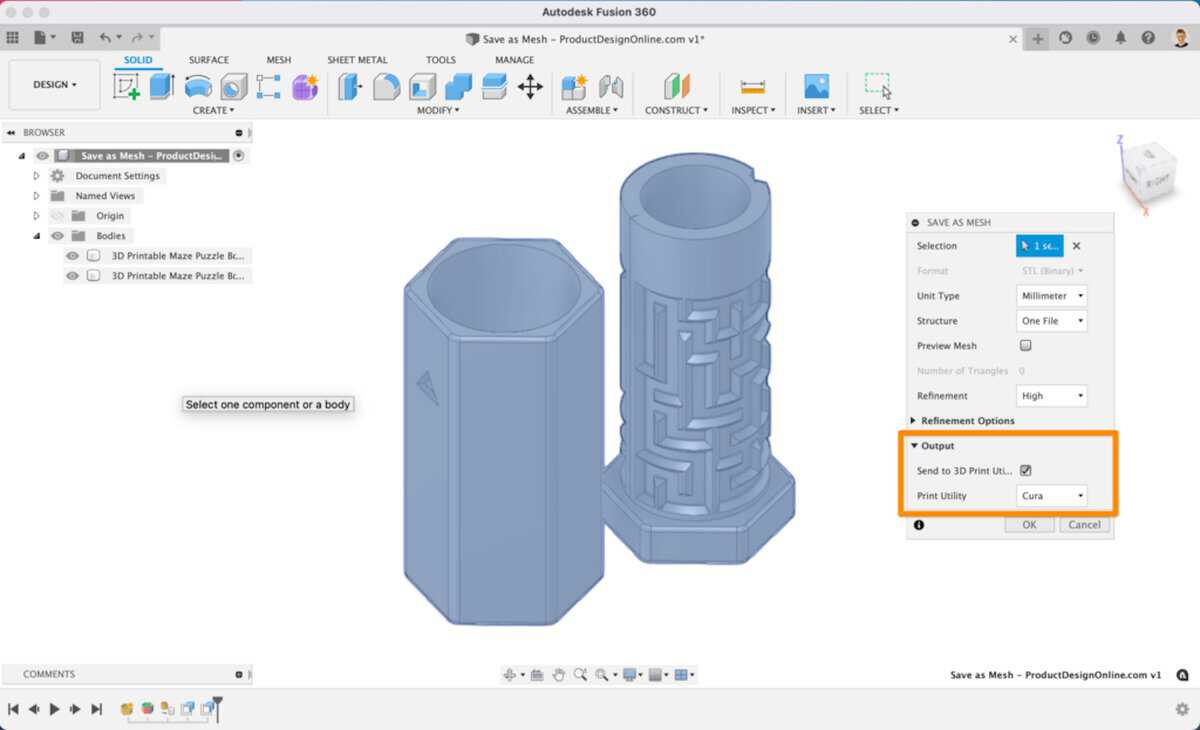
While the broader concept is Claude for CAD, its practical relevance becomes clearest in Claude for 3D printing workflows. The text-to-CAD capability allows users to generate first-pass models, refine geometries, and prepare files for additive manufacturing with reduced manual effort. For service bureaus, AI-assisted intake could help classify jobs by process, flag printability issues, and generate documentation. For internal engineering teams, it could accelerate the path from design intent to manufacturable concept.
However, Claude is not a replacement for specialised additive manufacturing software. Process-specific build preparation, support optimisation, simulation, machine connectivity, and quality management remain beyond its current scope. Early user reports on forums indicate mixed results: simple parametric shapes and hobbyist designs work reasonably well, while complex geometries, extrusions, and multi-step assemblies still produce errors. Claude for 3D printing, at this stage, is best understood as an efficiency tool rather than a production-ready design engine.
A Broader Industry Shift
The Claude for Creative Work launch extends beyond 3D modelling. Additional connectors cover Adobe Creative Cloud, Ableton, Splice, Affinity by Canva, SketchUp, and Resolume. Three art schools (Rhode Island School of Design, Ringling College of Art and Design, and Goldsmiths in London) are serving as early partners to pressure-test the tools in academic settings.
Autodesk’s willingness to connect Fusion to a third-party AI system signals a notable shift. As one industry analysis noted, even the largest CAD vendors now acknowledge they cannot compete with dedicated AI developers on language model capabilities, and are instead positioning their geometry kernels as the execution layer beneath AI interfaces. This shift mirrors a broader pattern in which AI systems gain sophistication in manufacturing workflows beyond the design phase. For Claude for CAD to mature from a workflow convenience into a production tool, however, geometry accuracy, constraint handling, and validation will need to improve significantly. The gap between designing in Fusion manually and using a text-to-model approach is beginning to narrow, but it remains substantial.


