



Researchers at Carnegie Mellon University's Department of Mechanical Engineering have developed a system that employs agentic AI to correct 3D prints during the manufacturing process, addressing one of additive manufacturing's persistent challenges. The multi-agent approach uses four specialised large language models working in concert to detect defects and adjust printer settings automatically, potentially reducing failure rates that have limited 3D printing's competitiveness against traditional manufacturing methods.
The research team designed the system to tackle quality control issues that have plagued 3D printing since its commercialisation. Whilst additive manufacturing has transformed prototyping and customised production, print failures remain substantial. Prusa3D reported approximately 7 per cent outright failures on its MMU2S system, with a further 19 per cent requiring user intervention. These figures contrast sharply with modern manufacturing standards approaching 0.1 per cent failure rates, making the technology less viable for high-volume production environments.
Agentic AI to Correct 3D Prints through Layer-by-Layer Analysis
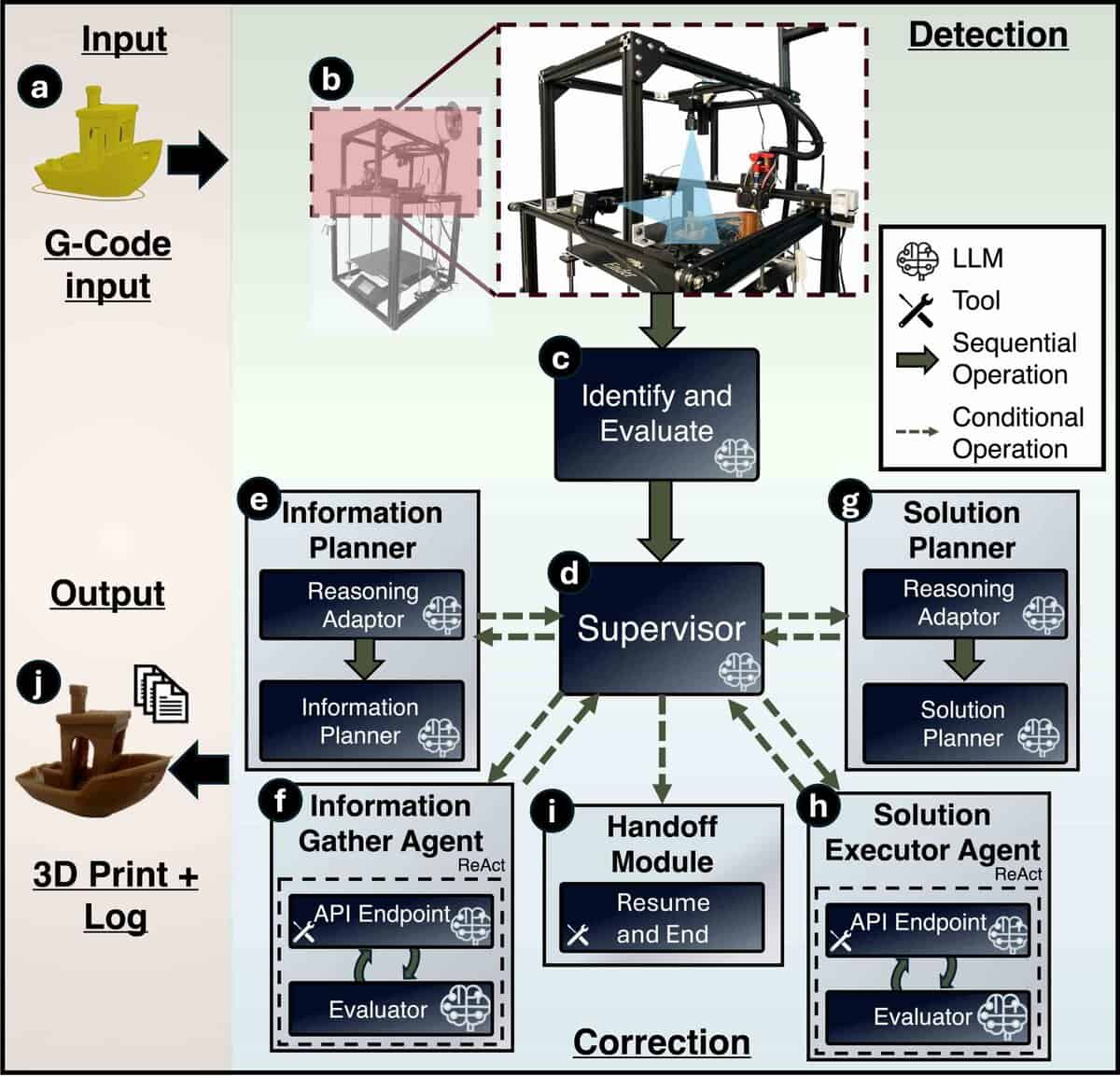
The Carnegie Mellon system deploys four distinct large language model agents, each handling specific aspects of quality control and correction. A visual-language model agent captures photographs after each printed layer, analysing the images for quality deviations and manufacturing defects. This real-time visual inspection identifies problems as they emerge rather than discovering failures after print completion.
A second agent examines current printer settings against the detected issues, determining which parameters require modification to address the identified problems. The analysis considers factors including temperature, extrusion rate, print speed, and material flow characteristics. This diagnostic agent bridges visual observation with mechanical adjustment requirements.
The information flows to a solution planner agent that develops actionable correction strategies. This agent translates diagnostic findings into specific parameter changes compatible with the printer's capabilities. The fourth agent, termed the executor, interfaces directly with the 3D printer through API connections to implement the planned adjustments.
A supervisory agent oversees the entire workflow, ensuring information remains relevant and current across all four operational agents. This coordinating function prevents conflicting instructions and maintains system coherence throughout multi-hour print jobs.
“The future is adaptive”
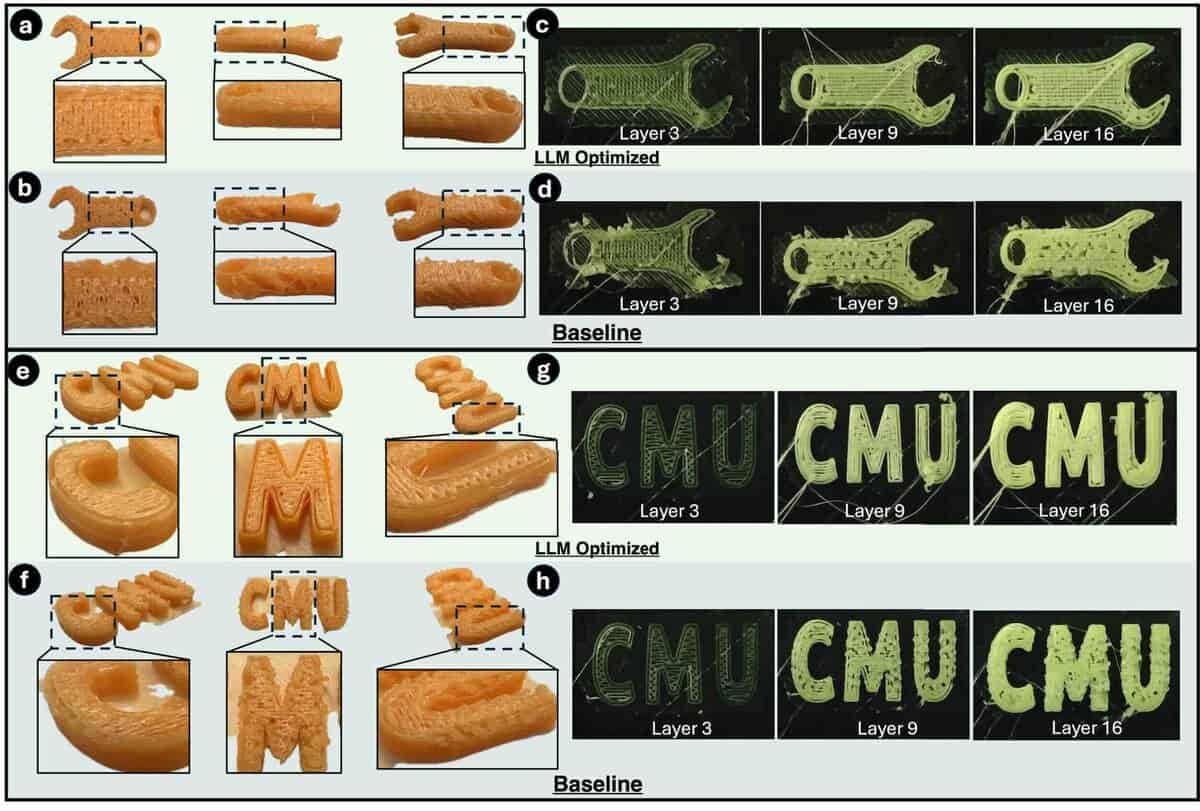
The research team's approach avoids specialised training datasets typically required for industrial AI applications. The system operates using base ChatGPT-4o with domain-specific structured prompts developed by the engineering team. This architecture simplifies implementation whilst maintaining effectiveness across different printer models and manufacturing scenarios.
"The future is adaptive. The integration of LLMs into the 3D printing process represents a significant advancement. As these models evolve, their ability to reason over richer, multimodal data will unlock even more capabilities. For now, this work provides a foundation for truly intelligent and autonomous manufacturing systems, capable of achieving unprecedented levels of precision and reliability."
- Associate Professor of Mechanical Engineering Amir Barati Farimani
The modular design allows the system to function across various printer makes and models through API standardisation. Rather than requiring manufacturer-specific customisation, the agent architecture adapts to different hardware through generalised communication protocols. This interoperability addresses a persistent challenge in industrial automation where proprietary systems limit cross-platform implementation.
The approach transforms cameras already present on many consumer and industrial 3D printers from passive monitoring devices into active quality control components. Current implementations typically stream footage for manual supervision, requiring human operators to identify problems and intervene. The agentic system automates this observation-decision-action cycle, reducing labour requirements whilst maintaining or improving quality outcomes.
For manufacturing operations running multiple printers simultaneously, the technology offers substantial efficiency gains. Traditional oversight requires dedicating personnel to monitor printer arrays, watching for failed adhesion, filament tangles, warping, and other common problems. Automated detection and correction allows a single operator to supervise larger printer farms, reducing per-unit production costs.
The research addresses economic barriers that have prevented 3D printing from displacing traditional manufacturing in high-volume applications. Seven per cent failure rates translate to significant material waste, consumed machine time, and delayed delivery schedules. Reducing failures to levels comparable with injection moulding or CNC machining makes additive manufacturing economically competitive for larger production runs.
Implementation challenges remain before widespread adoption occurs. The system requires reliable API access to printer control systems, which varies significantly across manufacturers. Some consumer-grade printers offer limited programmatic control, whilst industrial systems provide comprehensive parameter adjustment capabilities. Standardisation efforts would accelerate deployment across diverse hardware ecosystems.
The research represents convergence between artificial intelligence and physical manufacturing, applying language model capabilities developed primarily for text and image analysis to real-time process control. As AI systems gain sophistication in multimodal reasoning, their applicability to manufacturing oversight will likely expand beyond 3D printing into other production technologies requiring continuous quality monitoring.


