



Northrop Grumman has unveiled the Northrop Valen AESA radar, a compact, 3D printed wideband array that combines radar, electronic warfare (EW), and communications into a single multifunction design. The system, which was entirely funded through Northrop Grumman's internal research budget, is intended for crewed and uncrewed platforms operating across air and space domains.
The announcement, made on February 16, positions Valen as the newest addition to Northrop Grumman's advanced sensing portfolio. It arrives at a time when the United States Department of Defense (DoD) is increasingly pressing defence contractors to deliver internally funded, digitally engineered solutions that can move from design to production more rapidly.
Northrop Valen AESA Radar Explained
Valen is a multifunction Active Electronically Scanned Array (AESA) that uses a digitally controlled arrangement of antennas and sensors to steer radar beams electronically, without mechanical movement. This enables rapid detection, tracking, and imaging of targets across multiple directions simultaneously.
What distinguishes the Northrop Valen AESA radar from conventional arrays is its integration of three traditionally separate functions (radar, electronic warfare, and communications) into a single wideband aperture. The result is a lighter, smaller unit that Northrop Grumman states is more affordable than its predecessors while freeing up size, weight, and power capacity for other mission equipment on the host platform.
The system's performance draws on advanced micro-scale packaging techniques developed at Northrop Grumman's Microelectronics Centre. These techniques combine multiple semiconductor components into a single micro-sized package, enabling faster processing, improved thermal management, and lower power consumption within a reduced footprint.
Why 3D Printing Changes Radar Production
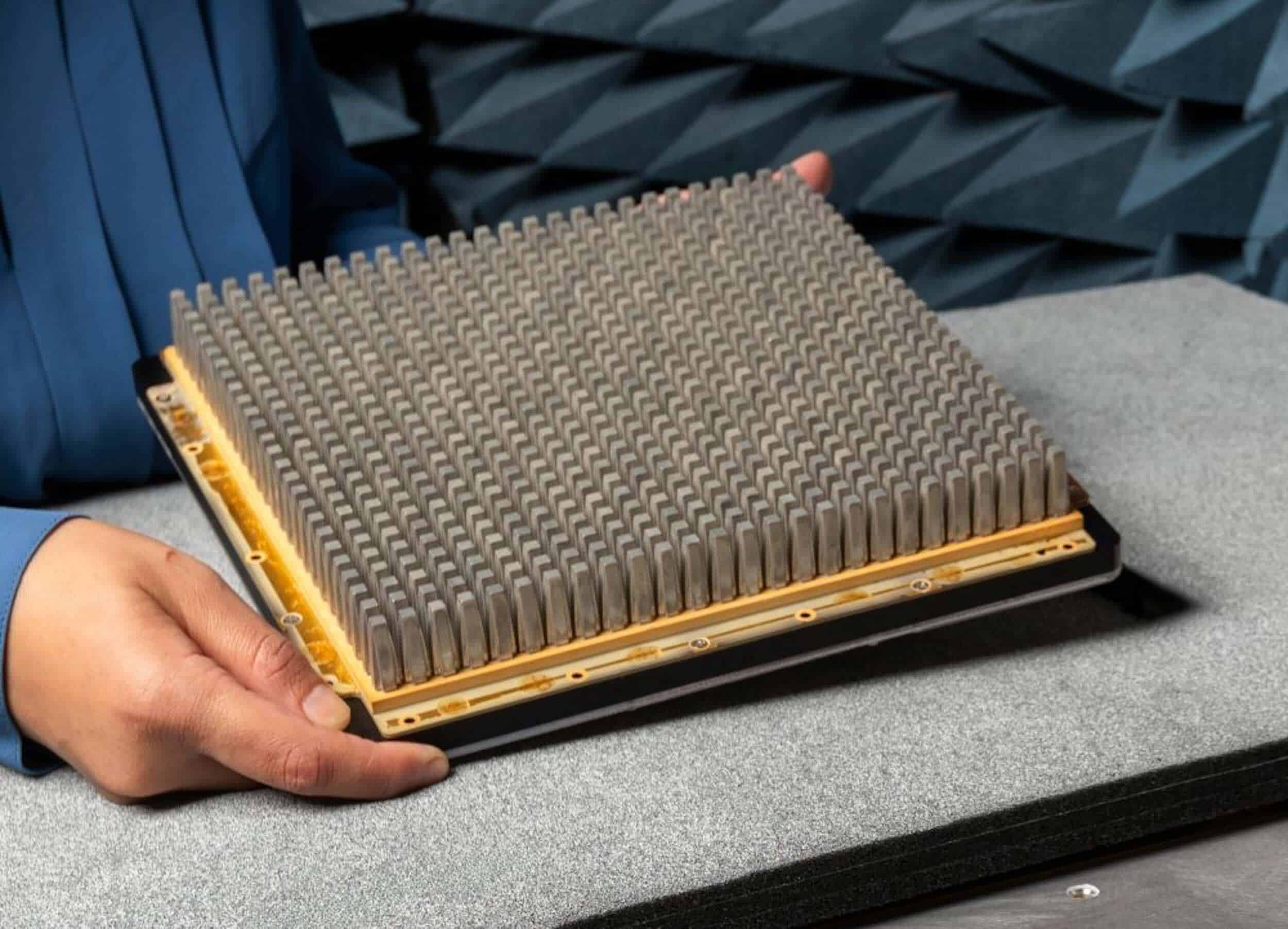
A defining feature of Valen is its reliance on additive manufacturing. Northrop Grumman states that Valen is digitally designed and 3D printed, an approach the company says reduces production timelines and supports faster delivery to operational units.
Traditional AESA front-end manufacturing typically involves complex machining of aluminium blocks to produce the waveguides that direct radio-frequency energy, a process that can be slow and costly. By adopting 3D printed AESA components, Northrop Grumman aims to bypass some of those constraints, drawing on its broader experience with additive manufacturing across defence programmes, which already includes US Air Force-authorised 3D printing of hypersonic test components. The company has previously partnered with firms such as SWISSto12 on 3D printed radio-frequency feed chains for satellite platforms, indicating an established digital engineering radar production capability. Other firms, including Optisys, which uses metal additive manufacturing to produce antenna and radar products for space missions, have demonstrated similar approaches to 3D printed RF hardware.
The shift also aligns with DoD expectations for digital engineering throughout the defence industrial base. Other programmes, including Raytheon's AN/SPY-6 family and Lockheed Martin's internally funded Vectis uncrewed aircraft, have similarly adopted digital design pipelines to accelerate development cycles.
Multifunction Sensing Across Platforms
Northrop Grumman has built Valen to open-architecture standards, meaning its hardware and software can integrate advanced sensor capabilities from across the company's portfolio and accept rapid updates over its operational life. This open-systems approach is designed to support multifunction sensing across radar, EW, and communications without requiring separate hardware for each role.
"Our warfighters require advanced situational awareness no matter what platform they're operating. Valen's design embodies the future of warfare, integrating cutting-edge technology, adaptability, and affordability to enable quick decision-making and effective mission execution."
— Krys Moen, Vice President of Advanced Mission Capabilities, Northrop Grumman
The company has already flight-tested Valen aboard a Northrop Grumman-owned Bombardier CRJ-700 aircraft. It intends to offer the system to the United States armed forces and allied nations for integration on a range of platforms where size, weight, and power constraints are critical.
Valen's Defence Sensor Implications
The Northrop Valen AESA radar represents a convergence of several trends shaping defence sensor development: internally funded innovation, additive manufacturing for scalable AESA array production, digital engineering, and open-architecture design. Whether those elements translate into contract wins will depend on how the system performs against competing offerings and how quickly it can be qualified for operational platforms. Nonetheless, Valen signals a clear direction for next-generation multifunction sensing, one in which 3D printed radar arrays could move from novelty to standard practice in defence electronics.


