



Researchers at the University of Illinois Urbana-Champaign have developed an artificial intelligence system that can pinpoint the origin of 3D printed parts down to the specific machine that manufactured them. The breakthrough technology, led by Professor Bill King from the Department of Mechanical Science and Engineering, uses machine learning to identify unique "fingerprints" left by individual 3D printers on fabricated components.
The research team discovered that each 3D printer creates distinctive signatures on parts during the manufacturing process, even when using identical machines, settings, and materials. This finding has significant implications for supply chain management, quality control, and manufacturing verification across industries that rely on additive manufacturing technology.
Dataset to identify the Origin of 3D Printed Parts
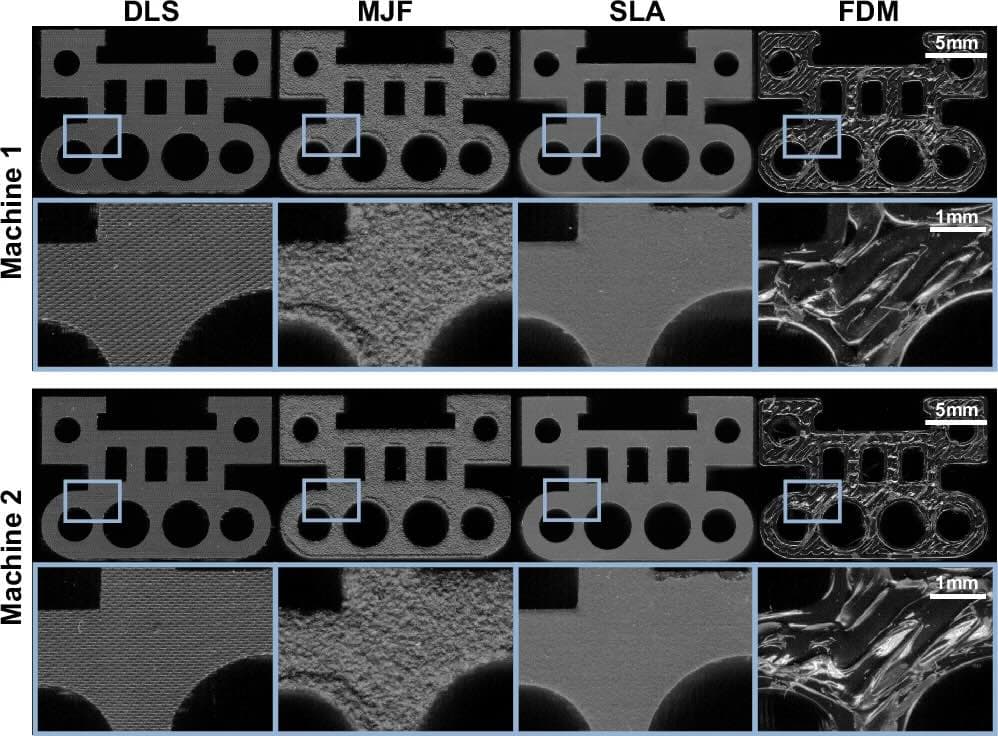
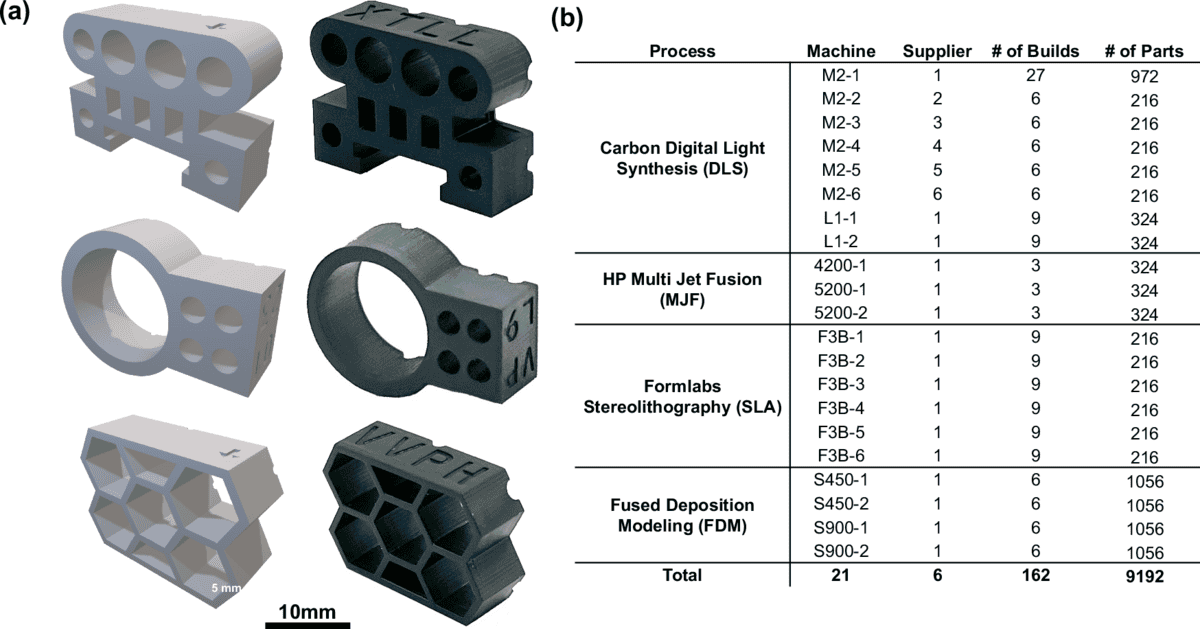
The research involved an extensive dataset comprising 9,192 parts manufactured on 21 different machines across four distinct additive manufacturing processes to study the origin of 3D printed parts. The study encompassed Digital Light Synthesis (DLS), Multi Jet Fusion (MJF), Stereolithography (SLA), and Fused Deposition Modelling (FDM) technologies, representing the spectrum of industrial 3D printing methods.
DLS parts were manufactured using RPU 70 material on Carbon M2 and Carbon L2 printers across six contract manufacturers. MJF components were produced in PA12 material on HP Jet Fusion 4200 and 5200 systems, with parts dyed black after printing. SLA parts utilized Formlabs Black material on Formlabs 3B+ printers, while FDM parts were created using ABS material on Stratasys Fortus 450mc and 900mc systems.
The research team designed three different part geometries—connector, plug, and lattice designs—inspired by real-world mechanical components. Each part measured within 27mm × 19mm × 8mm and featured unique serial numbers for tracking purposes. All materials were selected in black to maintain consistent appearance during imaging analysis.
AI System Development and Architecture
The ability to determine the origin of 3D printed parts relies on a sophisticated deep learning framework that processes high-resolution images captured using an Epson Perfection V39 flatbed scanner at 4800-dpi resolution, resulting in 5.3 μm pixels. Each part was scanned twice to capture different surface orientations.
The AI system employs an EfficientNetV2 architecture that achieved 98.5% accuracy in identifying the source machine among 21 printers. The system uses a novel approach involving random sampling of 448 × 448 pixel regions of interest (ROI) from each part image, followed by a voting procedure that aggregates predictions from multiple image patches.
"We are still amazed that this works: we can print the same part design on two identical machines—same model, same process settings, same material—and each machine leaves a unique fingerprint that the AI model can trace back to the machine. It's possible to determine exactly where and how something was made."
- Professor Bill King from the Department of Mechanical Science and Engineering, University of Illinois Urbana-Champaign
The research team evaluated multiple architectures including convolutional neural networks, transformers, and fine-grained image classification models, with all achieving accuracy levels above 95%. Training utilised 2,100 parts with 1,050 reserved for testing, maintaining a balanced dataset with 100 training parts and 50 testing parts per machine.
Technical Performance and Capabilities
The AI system demonstrates remarkable precision in identifying the origin of 3D printed parts across different scales and attributes. For machine identification, the model achieved 98.5% accuracy across all 21 printers, with only 16 misclassifications out of 1,050 testing parts. Notably, 12 machines were correctly classified with zero errors.
Beyond machine identification, the system can determine manufacturing processes with 100% accuracy and material composition with perfect precision across three DLS materials: rigid polyurethane (RPU), additive epoxy (EPX), and urethane methacrylate (UMA). The model also predicts supplier origin with 98.7% accuracy among six different contract manufacturers.
Perhaps most remarkably, the system can identify the specific location on the build tray where parts were manufactured, achieving 82.1% accuracy for exact position and 98.1% accuracy when considering adjacent positions. This translates to spatial resolution of approximately 5 cm across the build platform. The model can also determine which parts were produced in the same build session with 86.8% accuracy.
Resolution and Sampling Requirements
The research revealed that different additive manufacturing processes require varying image resolution and sampling areas for accurate identification. DLS parts can be accurately identified using sample areas as small as 200 μm × 200 μm, indicating that surface texture created by light-resin interaction provides sufficient fingerprint information at microscopic scales.
MJF and SLA processes require larger sample sizes of approximately 1 mm to exceed 90% accuracy, while FDM parts need sample areas of 3 mm due to their larger-scale deposition features. The model maintains high accuracy across pixel sizes ranging from 5.3 μm to 63.6 μm, demonstrating compatibility with various imaging systems including smartphone cameras and industrial scanners.
The voting procedure aggregates predictions from 16 random patches per part, with SoftMax outputs weighted by model confidence. This approach enables the system to leverage multiple high-resolution image sections while maintaining computational efficiency.
Applications and Industry Benefits
The technology addresses critical challenges in modern manufacturing supply chains where unauthorized changes to materials, processes, or equipment can go undetected until defective products reach the market. "Modern supply chains are based on trust," King noted. "Changes to the manufacturing process can go unnoticed for a long time, and you don't find out until a bad batch of products is made."
Applications extend beyond supply chain verification to include quality control optimization, counterfeit detection, and forensic analysis of manufacturing defects. The system enables objective verification of supplier compliance without requiring on-site inspections or supplier cooperation, particularly valuable for critical industries such as aerospace, medical devices, and defence.
The technology could also support regulatory compliance by providing objective evidence of manufacturing origin for import restrictions or tariff requirements. In industries requiring 100% part traceability, such as aviation and medicine, the fingerprint identification offers an additional layer of authentication beyond traditional labelling methods.
Future Research Directions
The research opens numerous avenues for advancement in manufacturing science and AI applications. King's team plans to explore extension to continuous manufacturing processes, anomaly detection for counterfeit identification, and integration with quality control systems for real-time monitoring.
Future work may include development of unsupervised models that could determine the number of machines in a supplier facility by analysing part photographs alone, without prior knowledge of facility operations. Semi-supervised approaches could reduce the training data requirements while maintaining accuracy.
The methodology's compatibility with multiple deep learning architectures provides flexibility for specialized applications, from edge devices with computational constraints to high-throughput industrial inspection systems. The research demonstrates that machine-specific texture patterns may exist across additional manufacturing processes beyond the four studied.
The study, “Additive Manufacturing Source Identification from Photographs using Deep Learning,” is available online. DOI: 10.1038/s44334-025-00031-2


