



Alisher Khojayev, a student at Los Angeles Valley College, has published what he describes as a “proof of concept for a low-cost MANPADS system”, a 3D printed missile prototype assembled for approximately $96 using consumer electronics and a desktop 3D printer. The full project documentation is freely available across two GitHub repositories: one for the launcher and rocket system and another for a distributed camera-node tracking system.
The design mimics a shoulder-fired MANPADS similar in form to the FIM-92 Stinger, and security analysts say the project illustrates how little now separates hobbyist hardware from functional guided weapons systems.
How the 3D Printed Missile Prototype Works
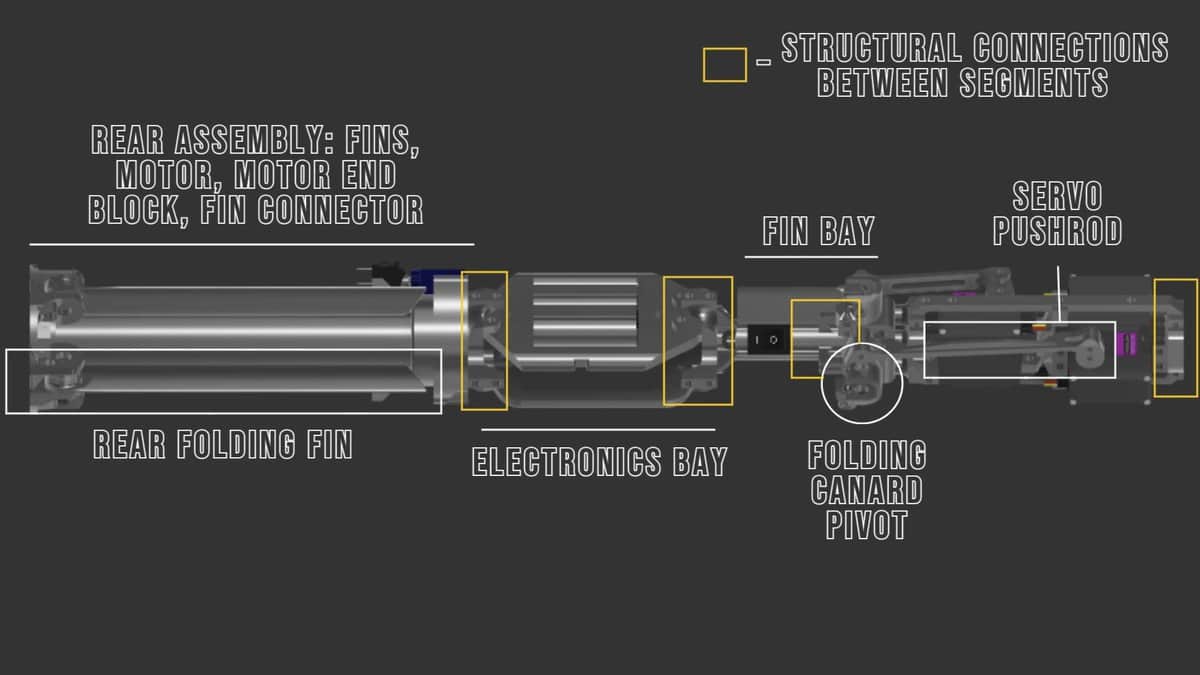
Conventional guided missile systems are typically produced in controlled defence facilities using specialised tooling, classified components, and supply chains that can take years to establish. Khojayev's prototype bypasses that entire infrastructure. The system comprises three elements: a launcher, a canard-stabilised rocket, and an optional distributed camera-node tracking network. Most structural components were produced in PLA using a consumer-grade FDM printer, assembled with heated threaded inserts, machine screws, and custom torsion springs formed from piano wire.
The launcher houses an ESP32 microcontroller paired with a QMC5883L compass, a NEO-6M GPS module, and a BMP180 barometric sensor. The rocket carries its own ESP32 and an MPU6050 inertial measurement unit (IMU) for orientation and angular velocity data during flight. A proportional-derivative control loop adjusts the canard control surfaces, small movable fins that steer the 3D printed missile in flight.
Activating the primary switch powers the launcher and creates a Wi-Fi network connecting to a control computer for telemetry monitoring. Communication between launcher and rocket before launch is handled through a wired umbilical cord carrying TX and RX serial lines. The second switch arms the rocket’s internal battery, at which point the onboard IMU measures roll orientation relative to the ground and automatically adjusts fin control logic in software, allowing the canards to respond correctly regardless of the rocket’s rotational position inside the launch tube. The design process began in OpenRocket before the assembly was modelled in Autodesk Fusion 360.
Why This Prototype Costs $96
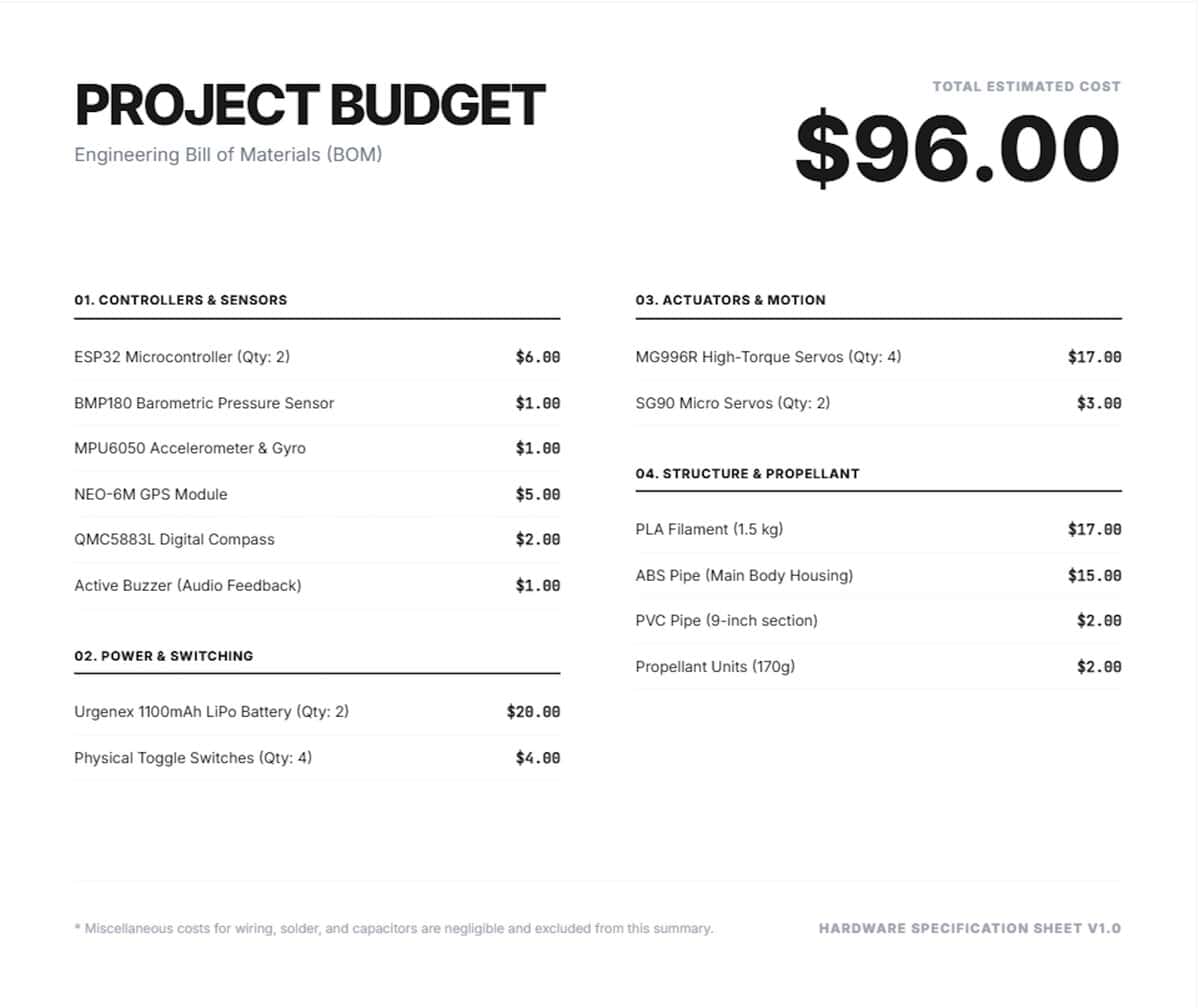
The cost disparity between Khojayev’s DIY MANPADS prototype and fielded military systems is significant. The U.S.-made FIM-92 Stinger costs approximately $480,000 per unit. The U.S. Air Force’s Counter-Air Missile Program (CAMP), targeting lower production costs, still aims at several hundred thousand dollars per launch. At $96, the 3D printed missile prototype is roughly 5,000 times cheaper.
The low-cost guided missile relies entirely on off-the-shelf components. The ESP32 microcontrollers, GPS modules, and IMU sensors are the same parts commonly found in smart home devices, typically retailing for a few dollars each. Combined with PLA filament and hardware store fasteners, the total bill of materials remains under $100.
"Modern tools, additive manufacturing, consumer electronics, and rapid prototyping have shattered the old barriers that once confined advanced hardware to well-funded laboratories."
— Alisher Khojayev, in a YouTube presentation of the prototype
Security Concerns Around 3D Printed Missiles
The publication of open-source weapons designs at this level of sophistication has prompted concern among defence analysts. A digital file is far easier to distribute than a physical weapon, challenging traditional arms control mechanisms. Non-state actors, some of whom are already using 3D printed weapons in active conflicts, or sanctioned nations could replicate such systems using widely available consumer technology.
The project does not exist in isolation. European defence company MBDA already incorporates 3D printed components in its missile systems. In Ukraine, where the ongoing conflict has accelerated 3D printing innovation at an unprecedented pace, small-scale laboratories have used hundreds of 3D printers to produce low-cost interceptor drones.
The trajectory from Cody Wilson’s 3D printed Liberator handgun in 2013 to a low-cost guided missile system in 2026 marks a significant escalation. Stronger materials such as carbon-fibre-reinforced polymers, combined with the miniaturisation of electronics, have eroded the boundary between hobbyist experimentation and military-grade technology.


