



The Bambu Lab Pop Mart settlement has brought a sudden end to a closely watched copyright dispute over unauthorised Labubu 3D models hosted on Bambu Lab's file-sharing platform, MakerWorld. The deal was struck just weeks before a trial scheduled for April 2, 2026, at the People's Court of Pudong New Area in Shanghai, a hearing that could have set a legal precedent for 3D model-sharing platforms worldwide.
Pop Mart, the Chinese collectibles giant whose Labubu character accounted for more than 30% of the company's total sales revenue in 2025, had filed suit against Bambu Lab and its affiliated entities over alleged violations of its reproduction, distribution, and information network dissemination rights. The case centred not on whether the infringing files should have existed; both sides agreed they should not, but on whether a platform bears legal responsibility for content uploaded by its users, a question rooted in 3D printing IP infringement law that now remains unanswered.
Bambu Lab Pop Mart Settlement Terms
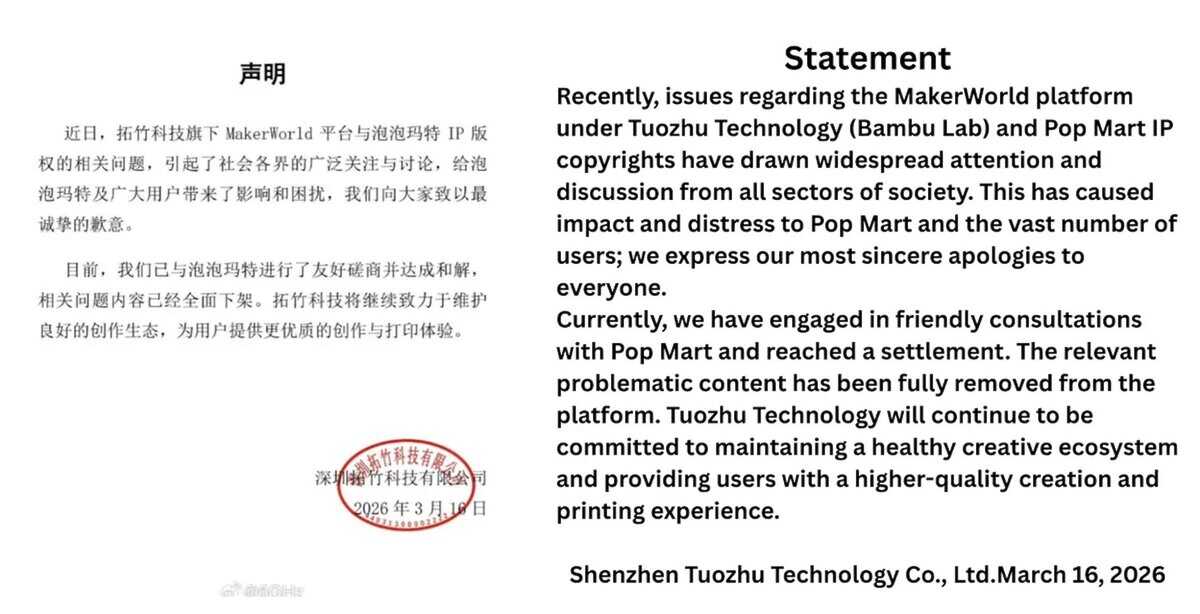
On March 16, Bambu Lab published a statement on its official Weibo account confirming that the two parties had reached a resolution through what it described as "friendly consultations." The manufacturer also issued a public apology, acknowledging that the dispute had caused disruption to both Pop Mart and MakerWorld's user base.
"Recently, issues regarding the MakerWorld platform under Tuozhu Technology and Pop Mart IP copyrights have drawn widespread attention and discussion from all sectors of society. This has caused impact and distress to Pop Mart and the vast number of users; we express our most sincere apologies to everyone."
— Tuozhu Technology (Bambu Lab), statement via Weibo, March 16, 2026
The company confirmed that all Labubu-related content had been removed from the MakerWorld platform. The financial terms of the Bambu Lab Pop Mart settlement have not been disclosed.
Safe Harbour Defence Never Tested
Bambu Lab had been widely expected to invoke the safe harbour principle as its primary defence, the legal doctrine that shields platform operators from liability for user-uploaded content, provided they act promptly upon notification of an infringement. That argument, however, never received its day in court.
The timing of the content removal had already drawn scrutiny. Files were taken down after the lawsuit was filed rather than proactively, a detail that could have complicated Bambu Lab's safe harbour liability position had the case proceeded. The commercial prominence of Labubu across China throughout 2025, with Chinese customs authorities seizing 1.83 million counterfeit Labubu products that year, made it difficult to argue the platform had no reasonable grounds to act earlier.
The outcome is arguably as significant for what it sidestepped as for what it resolved. A court ruling against Bambu Lab could have reshaped how platform liability is understood in the context of 3D model sharing, with potential ripple effects well beyond China.
Implications for 3D Printing Platforms
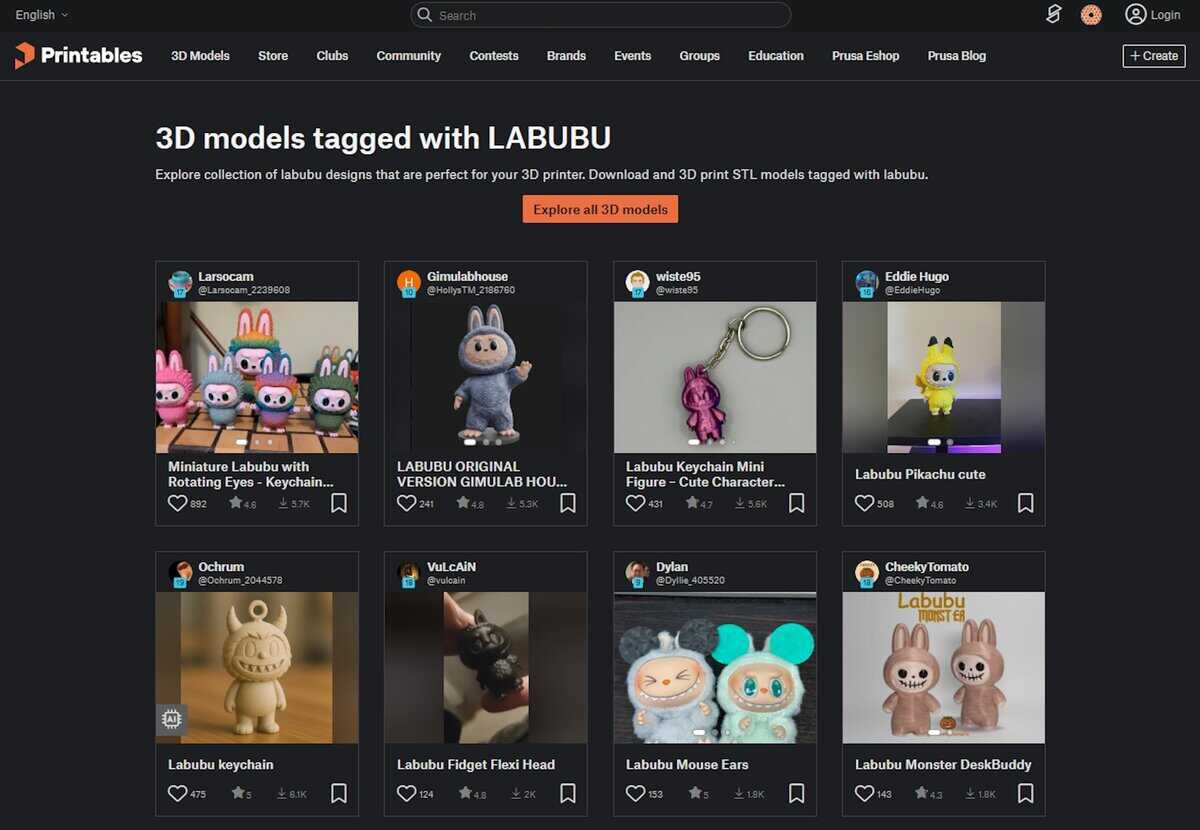
Western platforms including Printables, Thingiverse, Thangs, and MyMiniFactory continue to host Labubu-related files under existing safe harbour protections. No takedown requests have been reported from any of these sites, suggesting Pop Mart's enforcement efforts remain focused on the Chinese market for now.
However, the settlement sends a clear signal. IP rights holders are becoming more assertive, and platforms may need to shift towards proactive content moderation rather than relying on formal complaints before acting. The case is not an isolated one: Beijing-based HMCH Anime has also filed a separate lawsuit against Bambu Lab over alleged infringement related to the animated film The Legend of Hei, with that case currently in its first-instance trial stage. The company is also defending against a patent infringement lawsuit filed by Stratasys in the United States, underscoring the mounting legal pressure on one of the industry's fastest-growing manufacturers.
The broader industry context adds further pressure. MakerWorld, launched in 2023, now hosts over one million user-uploaded models and serves nearly 10 million monthly active users. As consumer-grade 3D printers move from niche hobbyist tools to mainstream manufacturing equipment, with commercial print farms now capable of mass-producing goods at a fraction of traditional costs, the friction between open-sharing culture and IP protection is only set to intensify.
The Bambu Lab Pop Mart settlement may have averted a precedent-setting ruling, but it has not resolved the underlying tension. With IP holders growing bolder and platform-scale 3D printing IP infringement becoming harder to ignore, the question of where platform responsibility ends and user liability begins will almost certainly return to a courtroom before long.


