



Biomimicry in aerospace is emerging as a key application area for nature-inspired material design as Tohoku University, in collaboration with Wuhan University of Technology, has developed a butterfly-inspired lattice structure that improves strength, impact resistance, and energy absorption. Conventional lightweight aerospace structures often suffer from localised stress concentration and unpredictable failure, making this development particularly significant. The findings, published in the International Journal of Mechanical Sciences, demonstrate how nature-inspired geometries can address long-standing limitations in lightweight aerospace materials.
The research focuses on translating the vein architecture of butterfly wings into engineered lattice structures that distribute stress more evenly, reducing the risk of sudden structural failure. Beyond aerospace, such structures may also find use in protective systems and infrastructure applications requiring high energy absorption.
Biomimicry in Aerospace Explained
Biomimicry in aerospace involves using nature-inspired designs to create materials and structures that optimise strength, weight, and durability. In this case, the vein network of butterfly wings serves as a model for developing lattice structures that manage stress more efficiently under load.
Unlike conventional engineering approaches that modify base materials, this method focuses on structural topology. By controlling how forces move through a material, engineers can improve performance without increasing weight, a critical factor in aerospace applications.
Butterfly Lattice Improves Structural Performance
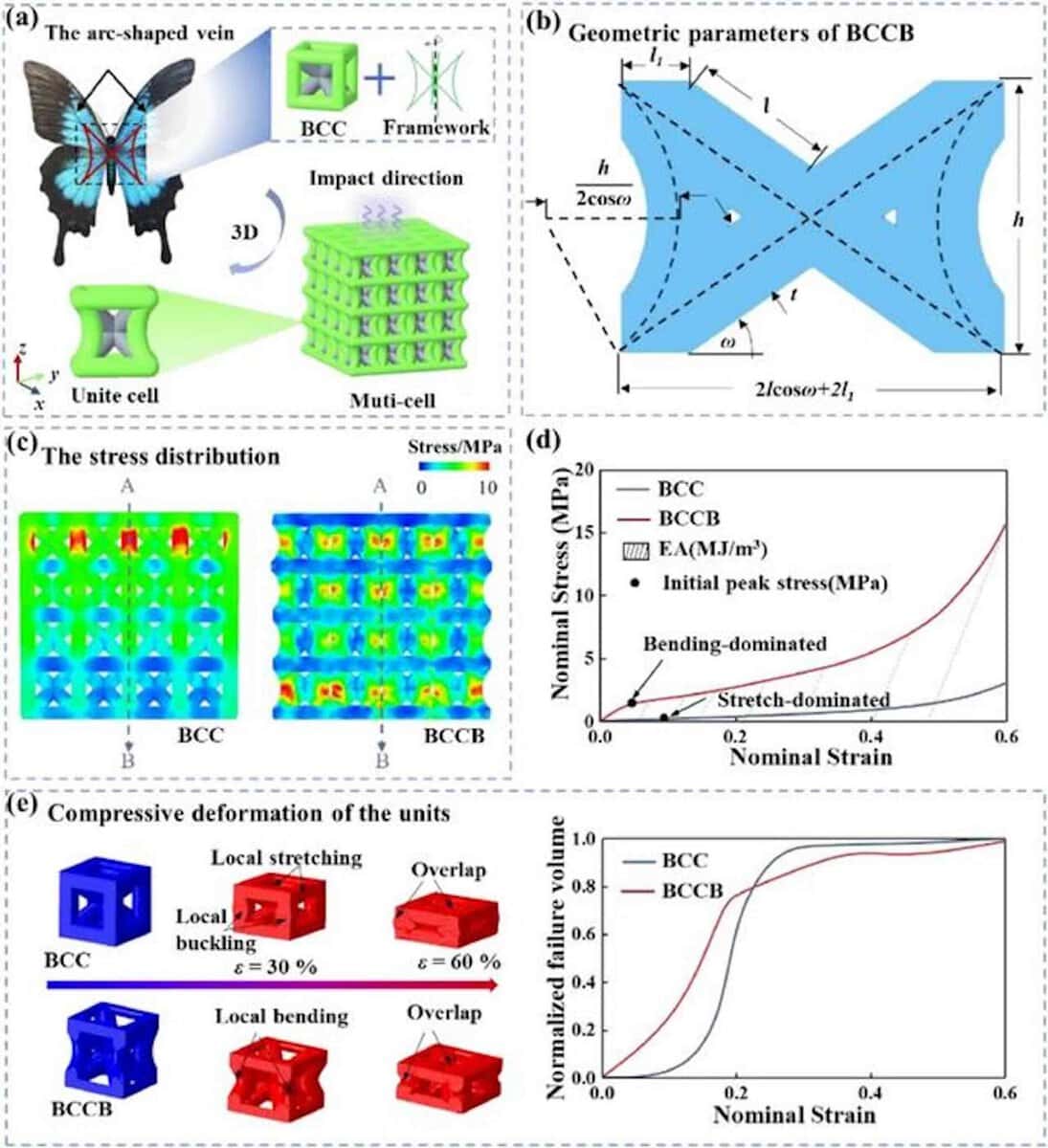
The newly developed structure combines curved and straight elements into an anisotropic lattice, meaning it directs forces along specific pathways rather than distributing them uniformly. This enables more predictable deformation behaviour under stress.
Traditional aerospace lattice structures often fail due to localised stress concentration. When force builds up at a single point, the structure can collapse abruptly. The butterfly-inspired design addresses this limitation by spreading stress across multiple pathways, allowing controlled deformation.
During testing, the structure exhibited a multi-stage response under load, transitioning from bending to stretching. This behaviour allows it to absorb more energy over time, rather than failing suddenly.
“This structural mechanism is particularly remarkable, since most lightweight lattice materials aren’t able to withstand forces like local buckling or shock.”
— Eric Jianfeng Cheng, Associate Professor, Tohoku University
Mechanical testing and simulations showed that the new lattice significantly outperforms conventional designs. The structure demonstrated up to six times higher energy absorption compared to traditional body-centred cubic lattices, while also achieving more than double the stiffness.
Importantly, these gains were achieved without a significant increase in density. This balance between strength and weight is central to biomimicry in aerospace, where even small reductions in mass can lead to substantial efficiency improvements.
The structure also maintained higher elastic modulus and plateau stress under both static and dynamic loading conditions, indicating improved resistance to deformation and failure.
Impact Testing and Manufacturing Advances
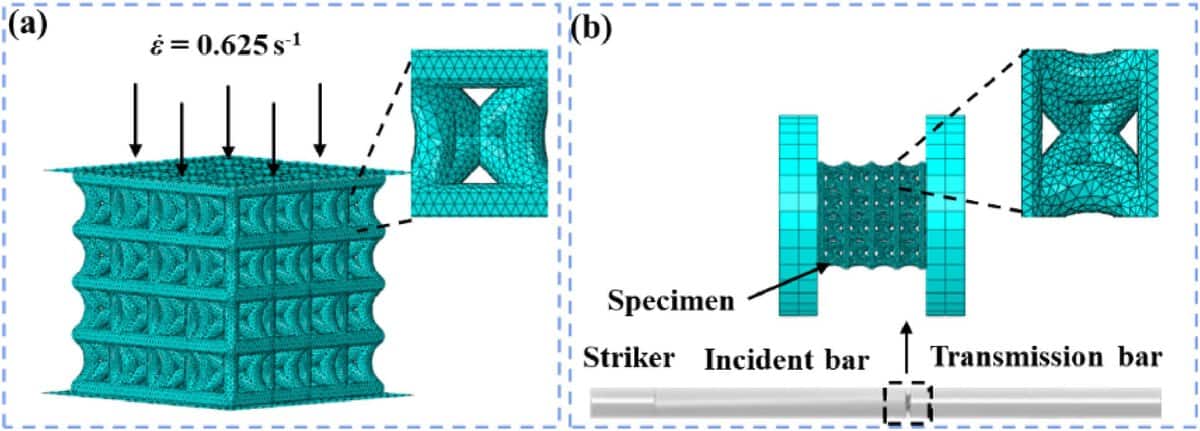
To evaluate performance under real-world conditions, researchers conducted high-speed impact tests using a Split Hopkinson Pressure Bar system. These tests simulate rapid loading scenarios, such as collisions or debris impact.
Results showed that the lattice distributes stress across multiple pathways instead of concentrating it along a single line. High-speed imaging confirmed that the structure forms an X-shaped deformation pattern during impact, reducing peak stress and delaying collapse.
Such behaviour is particularly relevant for biomimicry in aerospace, where managing sudden loads is essential for safety and structural reliability.
The development of this lattice structure is closely linked to advances in additive manufacturing. High-resolution 3D printing techniques were used to fabricate the intricate geometry, including curved and interconnected elements that are difficult to produce using conventional methods.
This highlights the growing role of additive manufacturing in enabling complex aerospace lattice structures, particularly as 3D printing in aircraft manufacturing continues to scale across next-generation aerospace programmes.
The ability to manufacture such structures at scale will be a key factor in their adoption within the aerospace industry.
Aircraft Design and Safety Implications
The study demonstrates how biomimicry in aerospace can influence future aircraft design by shifting the focus from merely resisting loads to managing them more effectively. Materials that distribute stress and absorb energy efficiently could improve crashworthiness and structural resilience.
Potential applications include airframe components, protective systems, and other areas where lightweight aerospace materials are required to withstand dynamic loads, as seen in recent deployments of 3D-printed titanium aircraft parts in flight-tested environments.
As aerospace design increasingly incorporates nature-inspired principles, biomimicry in aerospace is expected to play a central role in developing safer, lighter, and more efficient aircraft systems, while also supporting applications in other high-performance engineering domains.


