



Toyota Kirloskar Motor and Wipro 3D have partnered to establish an additive manufacturing centre of excellence, marking a significant step towards advancing 3D printing training and Industry 4.0 capabilities in India.
Toyota Kirloskar Motor has signed a Memorandum of Understanding with Wipro 3D to establish the facility at the Toyota Technical Training Institute (TTTI) in Bidadi, Karnataka. The initiative is positioned as a platform to integrate additive manufacturing into vocational education while strengthening India’s manufacturing talent pipeline.
Additive Manufacturing Centre of Excellence Overview
The facility will function as a dedicated hub for skill development, applied learning, and industrial innovation. Located within TTTI, the facility is designed to provide hands-on exposure to industrial 3D printing applications and real-world production environments.
Unlike conventional manufacturing processes that rely on tooling and material removal, additive manufacturing enables layer-by-layer production, reducing waste and enabling faster iteration in product development.
The collaboration introduces structured training programmes that include internships, apprenticeships, certification courses, and live industry projects. Wipro 3D will contribute technical expertise and curriculum design, ensuring alignment with current manufacturing requirements.
In addition to training, the platform will support practical applications such as rapid prototyping, development of production aids, and on-demand manufacturing of components. These capabilities are expected to help reduce lead times, improve assembly line efficiency, and enable more flexible manufacturing operations.
Toyota Wipro 3D Training Partnership
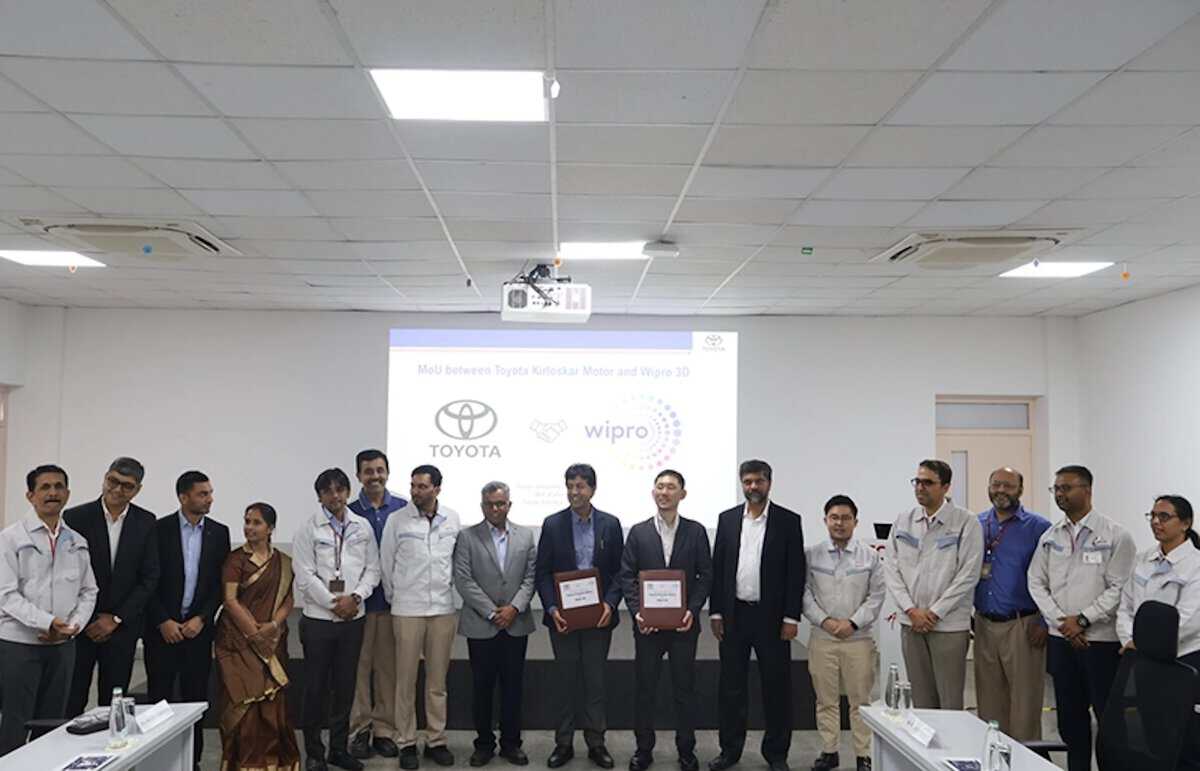
The Toyota Kirloskar Motor Wipro 3D partnership reflects a broader push towards industry–academia collaboration in advanced manufacturing. By embedding additive manufacturing within vocational training, the programme aims to bridge the gap between academic learning and industrial application.
TTTI, established in 2007, offers a three-year residential programme in disciplines such as automobile assembly, welding, painting, and mechatronics. The institute expanded its annual intake from 1,200 to 2,400 students in 2023, with half the seats reserved for female candidates, signalling a focus on inclusivity in technical education.
"This collaboration will play an imperative role in nurturing future-ready talent, while contributing meaningfully to the Government's Skill India Mission,"
— G. Shankara, Chief Strategy Officer, Toyota Kirloskar Motor
Wipro Infrastructure Engineering leadership also highlighted the strategic value of long-term partnerships in advancing additive manufacturing capabilities and co-developing industry solutions.
Industrial 3D Printing Applications in India
The initiative is expected to contribute to India’s growing focus on 3D printing training programmes and industrial adoption. By combining workforce upskilling with practical deployment, the initiative aligns with broader efforts supporting the growth of additive manufacturing in India.
The centre’s emphasis on lightweight and optimised component design supports key automotive and manufacturing use cases, including new product development and production efficiency improvements. These capabilities are increasingly relevant as companies adopt advanced manufacturing methods to complement traditional production processes.
Beyond technical training, the programme incorporates Kaizen-driven continuous improvement practices, reinforcing operational efficiency and long-term process optimisation. This approach positions the centre not only as a training facility but also as a contributor to broader manufacturing innovation.
Impact on India Manufacturing Ecosystem
The initiative highlights the growing role of collaborative models in building advanced manufacturing capabilities in India. By combining the automotive expertise of Toyota Kirloskar Motor with the additive manufacturing capabilities of Wipro 3D, the initiative creates a structured pathway for workforce development and industrial integration.
As demand for skilled professionals in 3D printing and digital production technologies continues to rise, such centres are likely to play a critical role in bridging talent gaps while accelerating technology adoption. The focus on hands-on training, industry alignment, and real-world applications reinforces the centre’s relevance in shaping future-ready manufacturing talent.
In the coming years, the TTTI initiative is expected to serve as a model for similar collaborations, contributing to India’s transition towards a more technology-driven and innovation-led manufacturing ecosystem.


