



Boston Micro Fabrication (BMF), the global leader in micro-precision 3D printing, announced the launch of BMF Clear, a new micro 3D printing clear resin engineered for applications requiring exceptional light transmission and micron-level accuracy, such as microfluidics, photonics, advanced optical components, biomedical devices and more.
With greater than 90% light transmittance, this breakthrough photopolymer joins BMF's expanding portfolio of high-performance materials, enabling engineers and innovators to additively manufacture complex, internally structured micro-scale devices that were previously unachievable with 3D printing. BMF Clear opens the door to high-fidelity innovation and broader application in critical research and commercial environments.
One such opportunity lies in scalable manufacturing, where BMF Clear enables the reliable production of complex micro-scale devices and integrated optical features that have traditionally been difficult to manufacture in volume. This includes applications such as microfluidic lab-on-a-chip systems with fiber alignment channels, freeform micro-lenses printed directly onto fiber optic tips, chip surfaces or sensor arrays, and integrated waveguides or photonic interfaces for sensing and data communication. By pairing true optical transparency with micron-level precision, the material facilitates the transition from early-stage innovation to real-world production.
Micro 3D Printing Clear Resin Specifications
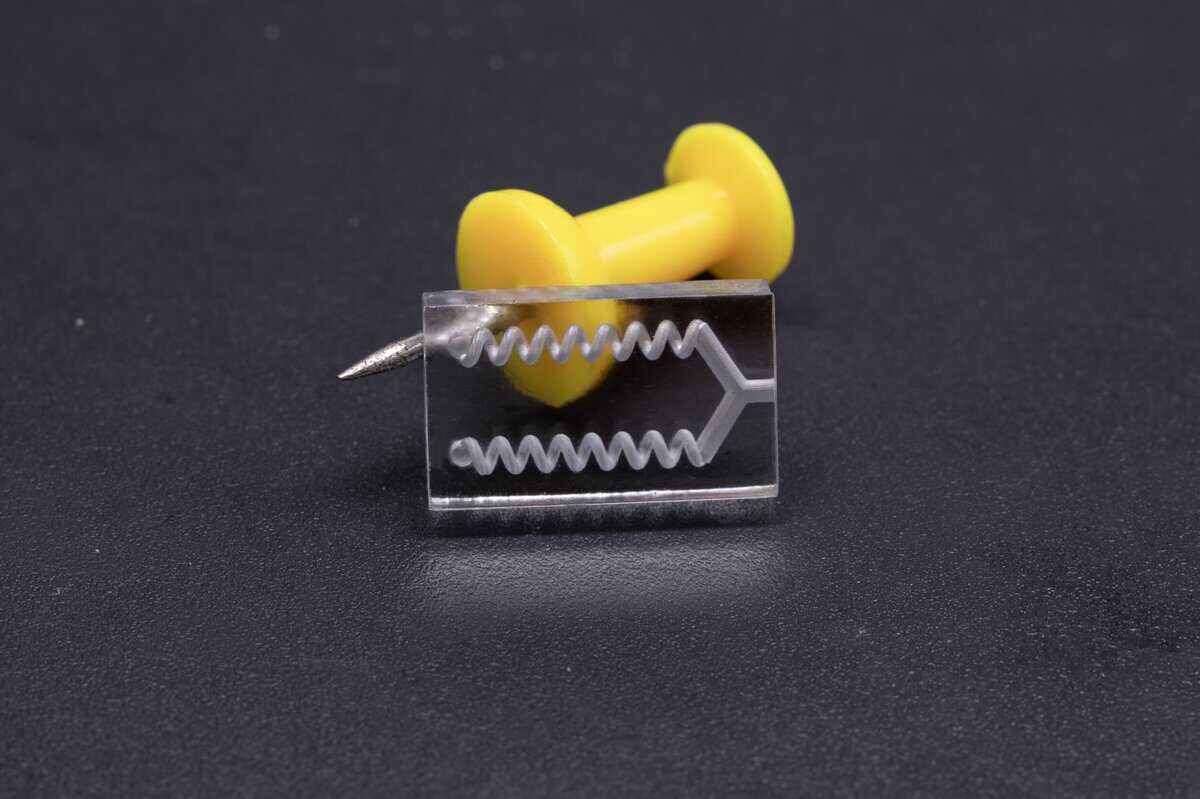
Designed for seamless integration with Boston Micro Fabrication's 10-micron and 25-micron systems, BMF Clear prints at layer heights between 10 and 50 microns. This compatibility extends across BMF's platform range, from advanced, high-end systems to the compact, benchtop microArch® S150 series, making it accessible for any lab or production environment. Ultra-high-resolution printing achieves fine features and superior surface quality critical for minimizing light scattering and improving transmission through internal channels. Combined with BMF's ultra-high-resolution printing capabilities, this means teams spend less time on what matters: developing and iterating on precision optical components.
"The research and engineering communities have long been constrained by the lack of truly transparent material suitable for micro-scale 3D printing. For years, achieving optical clarity with high print fidelity has led researchers to rely on traditional methods like PDMS soft lithography, which limits scalability, durability, and design flexibility. BMF Clear resin directly addresses this challenge, bridging the gap between prototyping and production-level micro-manufacturing. By combining true optical transparency with high-resolution printing, excellent surface quality, and the precision of our Projection Micro Stereolithography (PµSL) technology, we empower innovators to create complex geometries with internal channels and integrated optical features — driving the development of next-generation microfluidics, advanced sensors, electronics and beyond."
— John Kawola, CEO, Boston Micro Fabrication
Empowering Innovation Across Industries
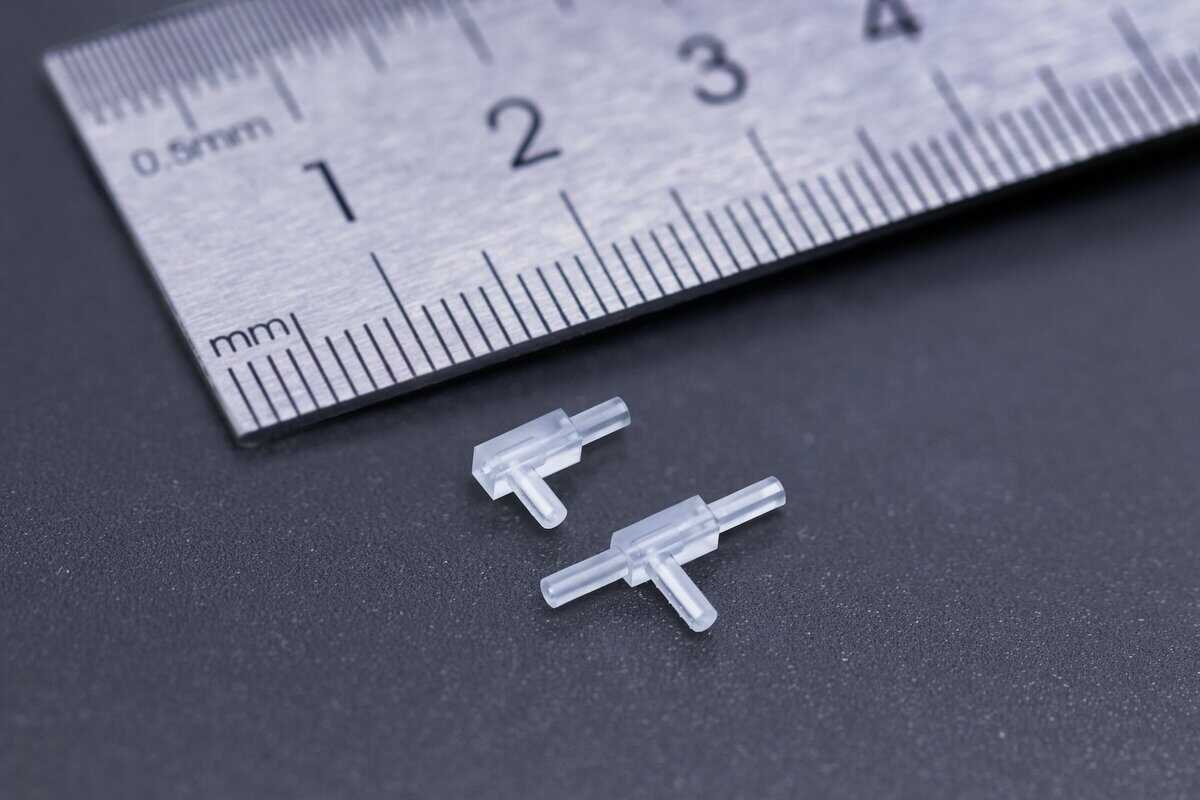
Historically, achieving true transparency in 3D printing, particularly at a micro level, has been challenging due to material absorptivity and surface roughness, which causes light to diffract. However, BMF Clear's optical clarity and superior surface finish create optically clear, perfusable channels, which position this micro 3D printing clear resin to transform various industries including biomedical, photonics, and optics. BMF Clear's transparency facilitates the creation of complex microfluidic devices and lab-on-a-chip systems, where precise visualization and analytical reliability are critical for processes such as cell culture and high-resolution droplet generation.
Within micro-optics and integrated photonics, BMF Clear supports the direct production of components like freeform lenses, complex waveguides, and other intricate optical interfaces directly onto fiber optic tips, chip surfaces, or sensor arrays, which are applications that have typically had significant challenges in manufacturing at scale. These applications are instrumental in producing advanced components, including fiber-to-chip couplers and complex microstructures for high-speed data communication, sensing, and imaging applications.
Having passed rigorous biocompatibility tests for skin irritation, sensitization, and in vitro cytotoxicity, there is significant scope in biomedical settings too. Medical device engineers can leverage the clear material's dimensional fidelity and clarity for device miniaturization, particularly in endoscopic systems, intraocular tools, and minimally invasive drug delivery systems where internal visibility and signal integrity are critical. BMF's new clear material is also ideal for creating advanced optical waveguides, sensors, and components for spectroscopy, where it enables the integration of on-chip optical windows and flow cells for UV/Vis or fluorescence analysis, eliminating complex assembly steps and alignment errors.
BMF Clear is available immediately through direct sales channels and the European distribution network of Boston Micro Fabrication. Pricing is available upon request.
About Boston Micro Fabrication: Boston Micro Fabrication (BMF) is the global leader in micro-precision 3D printing, with microArch systems based on its proprietary Projection Micro Stereolithography (PµSL) technology for product development, research, and industrial short-run production. Headquartered in Maynard, Massachusetts, BMF serves customers worldwide across medical devices, electronics, microfluidics, and fibre optics.


