



Walker Bruns, the owner of a bait and tackle shop in Ellendale, North Dakota, has built a 3D printed wheelchair for 15-month-old Millie McLean of nearby Edgeley, giving the toddler independent mobility after both her legs were amputated due to a congenital condition. The project took a month of continuous printing and was completed at no cost to the family.
Millie was born without tibia bones, a condition her parents, Anna and Alex McLean, first learned about during a prenatal scan. After consulting with specialists, the family made the decision to amputate both of Millie's legs. She is currently wearing casts while she awaits fitting for prosthetic limbs, a process that can take months for paediatric patients.
Building the 3D Printed Wheelchair
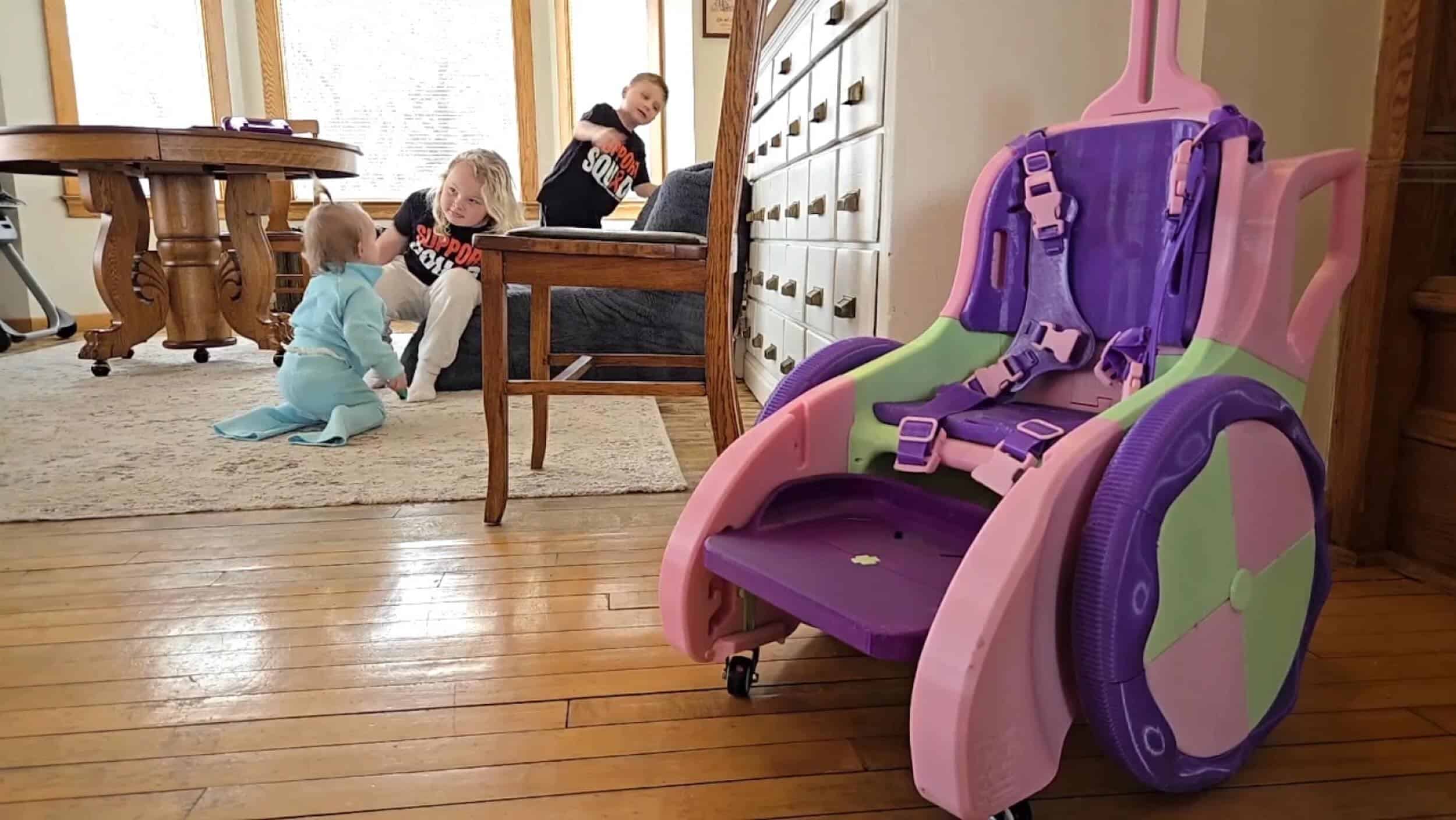
The McLean family had obtained the design files and blueprint for a toddler mobility trainer from a non-profit organisation, but lacked the means to fabricate it. Bruns, who owns a consumer-grade 3D printer alongside his shop, volunteered to take on the build.
"Right away it was daunting. I started off with the wheel pieces, smaller pieces, and I thought, 'There is no way this is going to become a wheelchair, let alone be something that can be utilised daily,'" Bruns says.
The finished 3D printed wheelchair, assembled in purple, pink, and green, functions as a toddler mobility trainer, allowing Millie to move around her home alongside her siblings: twin sister Audrey, and older twins Julia and Bronson, aged five. Bruns refused any payment for the work.
"Walker has always been … he would give you the shirt off his back, and that is what he did. He refused payment. He did this out of the goodness of his heart."
— Alex McLean, Millie's father
Community-Driven Assistive Technology in Action
The project highlights a growing trend in community 3D printing volunteers using consumer-grade hardware to produce custom assistive devices. Unlike mass-manufactured mobility aids, a 3D printed wheelchair can be tailored to a child's exact measurements and adjusted as they grow, often at a fraction of the cost.
Globally, the personalised medical device sector is expanding as additive manufacturing becomes more accessible. Consumer FDM printers, once limited to hobbyist applications, are now capable of producing functional assistive technology components. Organisations like So Everybody Can Move provide open-source designs for exactly this purpose, bridging the gap between clinical need and community fabrication capability. The trend is particularly relevant in markets like India, where distributed manufacturing networks and a growing maker community could address gaps in affordable paediatric assistive devices, a direction already being explored by institutions like IISc with 3D printed rehabilitation gloves.
For Bruns, the most significant moment came when Millie first sat in the completed device.
"Seeing Millie sit in it that first night, I had to look away; I didn't want to tear up. The cherry on the cake was seeing Millie sit in it and start laughing when they pushed her around. That was unreal."
— Walker Bruns, builder of Millie's mobility trainer
Advocacy for Paediatric Prosthetics Coverage
Beyond the immediate impact of the 3D printed wheelchair, the McLean family is now turning its attention to legislation. The family and other advocates are pushing North Dakota lawmakers to require insurance companies to cover a greater share of prosthetics costs for children.
"Sometimes I feel like we are surviving, not thriving. You put one foot in front of the other and you do the best you can. But it takes a village, and there is something to be said about living in a small town; what you get from that is not replaceable," Anna McLean says.
Families seeking resources or support can visit the Amputee Coalition or So Everybody Can Move.
The case underscores the widening role of the 3D printed wheelchair, alongside 3D printed prosthetics and other custom mobility devices, in paediatric care, and the potential for community makers to fill gaps that traditional healthcare systems leave open. As consumer additive manufacturing continues to mature, stories like Millie's may become less exceptional and more routine.


