



The Bambu Lab OrcaSlicer controversy has intensified after the Chinese 3D printer manufacturer issued legal threats against an independent developer who restored direct cloud printing functionality to the popular third-party slicer. The dispute has reignited a broader debate about open-source ethics, ecosystem control, and user rights in the desktop 3D printing space.
OrcaSlicer, originally forked from Bambu Studio in 2022, grew into the community's preferred slicer by shipping features, such as scarf seams, crosshatch infill, and built-in calibration suites, well ahead of commercial alternatives. The legal action against the fork arrives as Bambu Lab faces mounting pressure on multiple fronts, including a patent infringement case brought by Stratasys and a recently settled copyright dispute with Pop Mart.
Bambu Lab OrcaSlicer Controversy Origins

In January 2025, Bambu Lab removed OrcaSlicer's ability to send print jobs directly to its printers over the cloud. The company required users to instead route all connections through its standalone middleware application, Bambu Connect. OrcaSlicer's developers declined to adopt the two-app workflow, leaving users with a difficult choice: update their printer firmware and lose direct OrcaSlicer printing, or remain on outdated firmware indefinitely.
Independent software developer Paweł Jarczak subsequently created a fork called 'OrcaSlicer-bambulab' that restored the lost cloud printing path. The project gained traction quickly, receiving several public releases on GitHub. However, Bambu Lab contacted Jarczak directly, demanding the fork's removal and presenting a cease-and-desist letter.
Allegations and Developer's Response
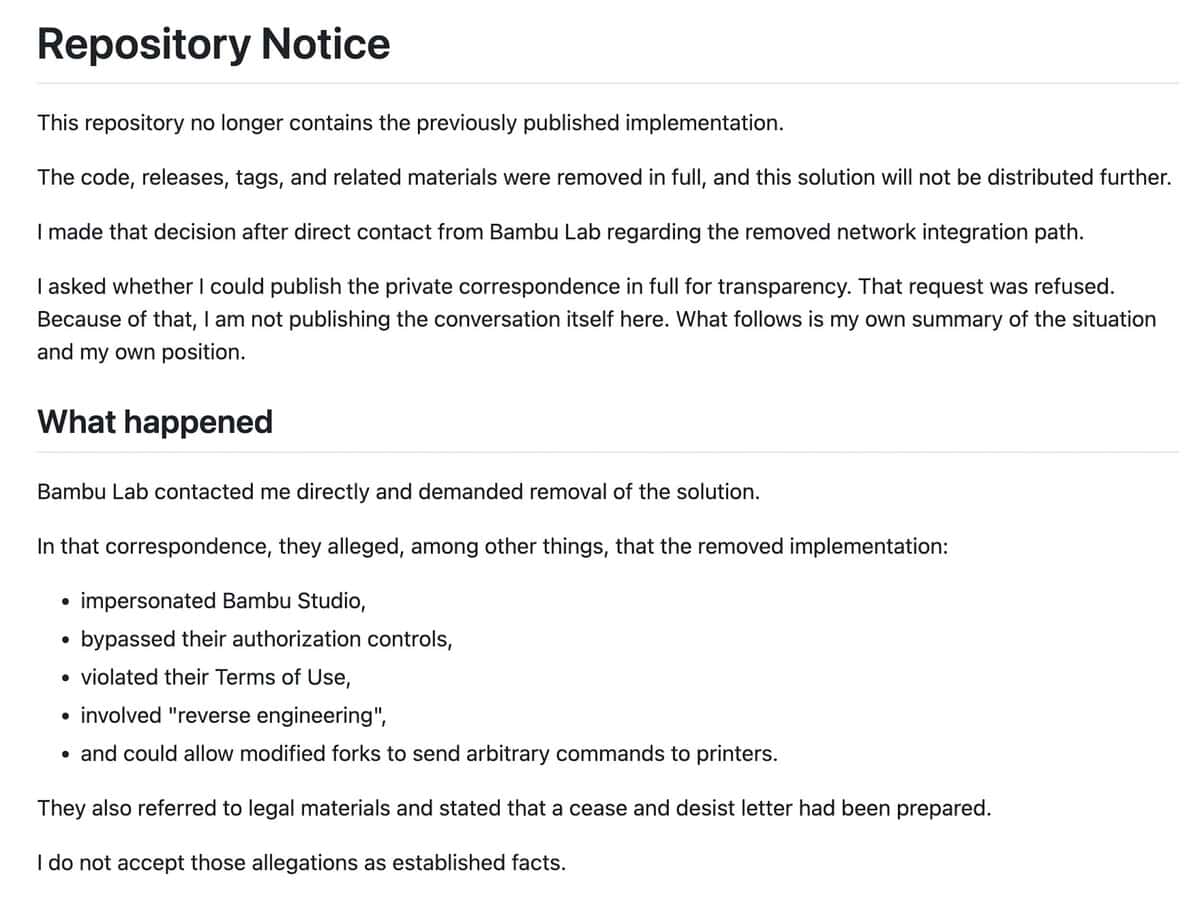
Bambu Lab accused Jarczak of impersonating Bambu Studio, bypassing authorisation controls, violating its Terms of Use, reverse engineering proprietary software, and enabling modified forks to send arbitrary commands to printers. Jarczak requested that Bambu Lab identify the specific code paths, commits, or legal provisions at issue, but stated that no precise technical or legal clarification was provided.
"I explicitly pointed out that, according to Bambu Lab's own explanation, the reason the method still worked was simply that they had not disabled that path yet."
— Paweł Jarczak, Developer of OrcaSlicer-bambulab
Jarczak maintained that his work built upon publicly available Bambu Studio source code and did not redistribute Bambu Lab's proprietary networking plugin binaries. He highlighted that Bambu Studio itself is released under the AGPL-3.0 licence, a copyleft open-source licence inherited from PrusaSlicer, the codebase upon which Bambu Studio was originally built. This distinction, Jarczak argued, is central to the AGPL licence dispute surrounding the project.
Enforcing the Bambu Connect Requirement
Bambu Lab has not issued a public statement on the matter. However, the company has previously framed the Bambu Connect app requirement as a security measure, citing the need to control authorisation for critical printer operations and to prevent the execution of arbitrary commands through unverified third-party software. The company publicly introduced a newer authorisation-control model for printer commands as part of this shift.
Critics argue that the approach amounts to 3D printing ecosystem lock-in, drawing comparisons to restrictive platform strategies in the consumer electronics industry. Users on the Bambu Lab subreddit described the company as the "Nintendo of 3D printing," referencing the gaming firm's well-documented enforcement posture toward third-party developers.
Implications for Open-Source Slicers
OrcaSlicer has long been regarded as a leading third-party slicer for FDM 3D printing, built on a development model of open contribution and rapid iteration. That philosophy sits uneasily alongside Bambu Lab's tightening control over its printer ecosystem.
Jarczak has since announced plans to develop support for open-source Klipper-based printers, citing a growing risk that continued compatibility with Bambu Lab's ecosystem may become unviable.
The Bambu Lab OrcaSlicer controversy underscores a widening fault line in desktop 3D printing: the tension between manufacturers seeking to secure their ecosystems and a user community that expects the interoperability and transparency that open-source foundations historically provide. Bambu Lab has yet to offer a public response.


