



APMA (Automotive Parts Manufacturers' Association), the body representing Canada's automotive supplier industry, has unveiled two new electric vehicle prototypes at the 2026 Canadian International AutoShow (CIAS) in Toronto. The centrepiece of the reveal is Project Arrow Vector, a battery-electric crossover featuring an AI designed, 3D-printed polymer and aluminium chassis, an estimated range of 550 kilometres, and Level 3 autonomous driving capability. Alongside it, the association presented Project Arrow Borealis, a longer-horizon concept van targeting Level 5 autonomy.
The twin unveilings mark the second phase of Project Arrow, a national vehicle programme launched in 2023 to demonstrate that Canada's supplier ecosystem can design, engineer, and build a complete zero-emissions vehicle domestically. Ontario Tech University serves as the programme's lead build partner, with more than 80 Canadian suppliers contributing components and systems across both prototypes.
Project Arrow Vector's 3D-Printed Chassis
Project Arrow Vector is positioned as the near-term platform of the two concepts, aligned to what APMA describes as the "2030 mobility environment." The crossover builds on the original Project Arrow show car first displayed in 2023, arriving with sharper body styling and a higher output, now rated at 650 horsepower (approximately 480 kW), up from the previous model's 550 hp.
The headline technical feature is the chassis. According to APMA, it was designed using artificial intelligence tools and then 3D-printed from a blend of polymers and aluminium, a method intended to reduce both weight and component count. The approach builds on the programme's first phase, in which 3D printing consolidated what would traditionally have been 30 to 40 separate chassis pieces into just three major sections (left, right, and an upper cradle), a significant reduction in part complexity for structural automotive assembly.
The estimated driving range stands at up to 550 kilometres, and the vehicle integrates Level 3 automated driving, which permits hands-off and eyes-off operation under defined conditions.
"Project Arrow began as a national ambition to prove that Canada could design and build its own zero-emissions vehicle. With Phase 2.0 we are advancing that platform into the technologies, systems and industrial capabilities that will define mobility in the 2030s and 2040s."
— Flavio Volpe, President of APMA
Project Arrow Borealis Targets 2040
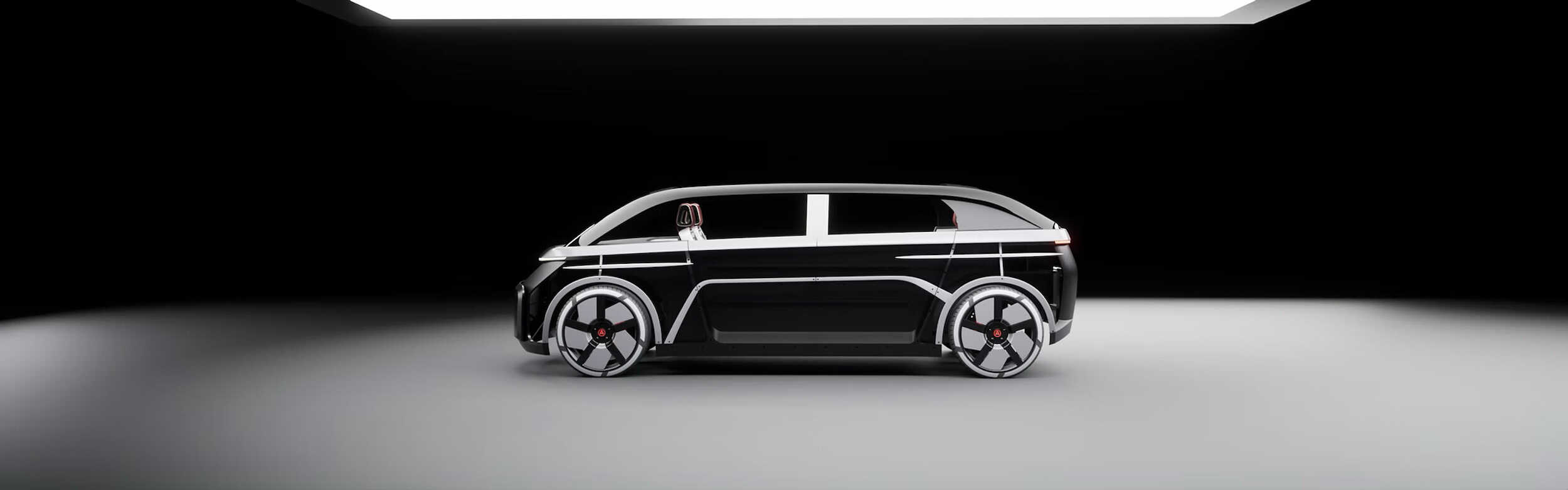
Where the Vector addresses a nearer horizon, Project Arrow Borealis extends the programme's ambitions to 2040 and beyond. The van concept features a fully 3D-printed metal-alloy chassis and powertrain, Level 5 autonomous driving (requiring no human input), and a projected range of up to 1,500 kilometres on a single charge.
The interior underscores the autonomous brief: four seats face one another across a central table, dispensing with traditional driver controls. Borealis also incorporates vehicle-to-infrastructure communication systems designed for integration with future smart-city networks.
Production Outlook Remains Uncertain
The two prototypes sit on markedly different timelines. APMA positions the Vector crossover as potentially realisable by 2030, while the Borealis is not anticipated before 2040. Both timelines, however, carry caveats. When Project Arrow was first announced in 2021, initial plans referenced series production by 2025 with an annual output of around 60,000 units, targets that have since been quietly set aside.
Neither prototype is a confirmed production vehicle. Key details such as battery sourcing, cell chemistry, and per-unit cost have not been disclosed. The viability of 3D-printed structural components at volume remains an open question: while additive manufacturing of chassis parts is established in motorsport and low-volume production, it is still in its early stages for high-volume automotive segments, constrained by both cost and throughput.
The reveal also arrives at a sensitive moment for Canada's automotive sector. Recent policy shifts have eased tariffs on Chinese-made electric vehicles, increasing competitive pressure on domestic manufacturers. The initiative represents one response to that pressure, an effort by Canada's parts makers to position themselves not merely as suppliers, but as architects of complete vehicles.
Canadian Additive Manufacturing on Display
Phase 2.0 of Project Arrow is supported in part by the Federal Economic Development Agency for Southern Ontario (FedDev Ontario) and the Ontario Vehicle Innovation Network (OVIN). For the additive manufacturing industry, the Project Arrow Vector prototype offers a prominent case study for 3D-printed structural automotive components, particularly the polymer-aluminium chassis, and the broader question of when and how such methods can move from prototype showcase to series production.
Other OEMs are already making that transition for smaller components: BMW has committed to 3D printing 18,000 centre console carriers per year for a 2027 vehicle, consolidating a seven-part assembly into a single printed piece. Whether additive methods can scale to full chassis structures at comparable volumes remains the challenge that Project Arrow Vector will need to address.


