



When a single prototype turns into a thousand functional components, quality becomes more than a benchmark—it becomes the backbone of your production system. That's what makes scalable 3D printing success both an opportunity and a challenge. In a world where additive manufacturing is rapidly shifting from prototyping to production, quality control (QC) is emerging as the hidden enabler of success.
This guide is for manufacturers, engineers, and quality teams who are scaling additive processes. You'll discover how QC can either empower your production goals—or quietly sabotage them if ignored. For teams looking to ensure readiness at scale, services like QCADVISOR factory audit can help identify gaps and build a solid foundation for consistent quality.
After all, no matter how innovative your 3D printer is, if your outputs are inconsistent, your growth stops short.
What does scalable 3D printing success mean?
Scalable 3D printing success refers to the ability to move from producing one or a few parts to consistently manufacturing large volumes without compromising on quality, speed, or cost-efficiency. It's not just about printing more—it's about printing better at scale.
However, additive manufacturing introduces challenges not found in traditional methods. Unlike CNC or injection molding, where repeatability is baked into rigid processes, 3D printing systems are material-sensitive, environment-sensitive, and data-sensitive. Scaling without tight process control can quickly result in quality degradation.
Here are some of the core challenges that must be overcome when scaling up 3D printing:
- Speed of production – Maintaining quality as print speed increases
- Material cost efficiency – Reducing waste and managing feedstock costs per part
- Consistency across batches – Ensuring that each print matches previous runs
- Regulatory compliance – Meeting industry-specific standards at volume
- Ease of post-processing – Streamlining support removal, cleaning, and finishing steps
Why is quality control essential for 3D printing?
At the heart of scalable 3D printing is control. Quality control impacts every phase of the additive workflow—from raw material input to final part inspection. Without it, defects go undetected, repeatability is compromised, and product failures multiply.
In industries like aerospace and healthcare, a failure due to poor QC isn't just costly—it's dangerous. For example, an improperly calibrated machine might introduce porosity in a flight-critical part, while a mismanaged resin batch could cause toxic leachables in a medical implant. Both have occurred in real-world cases where QC was neglected.
Effective quality control ensures:
- Higher part acceptance rates
- Safer, more durable end products
- Lower rework and scrap costs
- Smoother certification processes
- Faster, more confident scaling
What are the common quality issues in 3D printing?
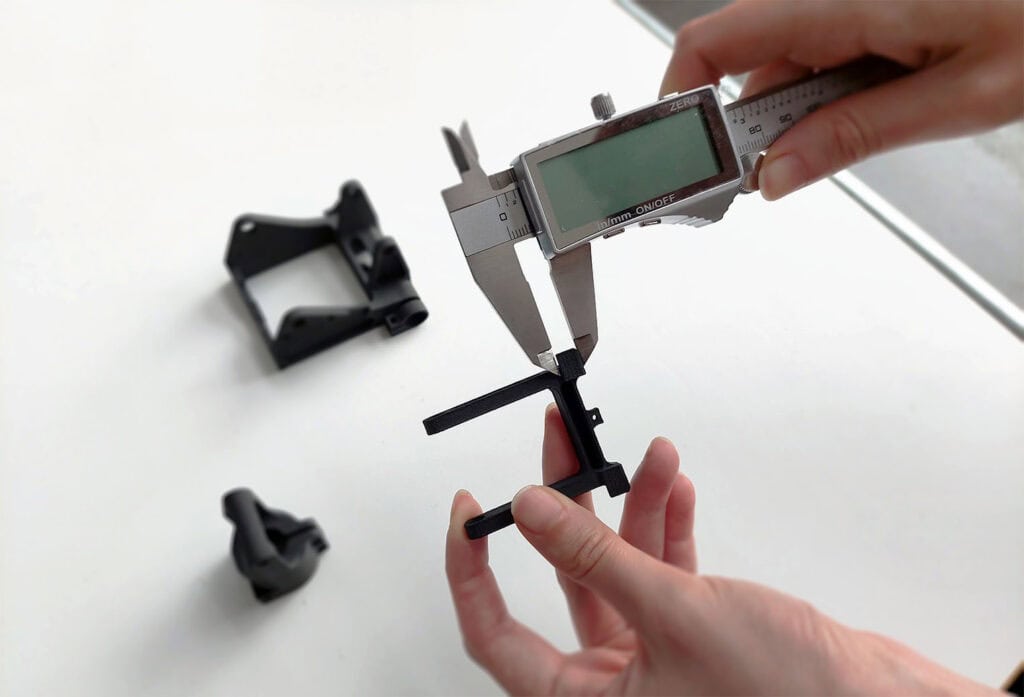
3D printed parts are prone to a unique range of defects—many of which aren't visible to the naked eye. This makes robust inspection and defect tracking critical to avoid failures in performance or costly rejections down the line.
One common issue is warping, which occurs when parts distort due to uneven cooling or thermal stress during printing. Another frequent problem is layer adhesion failure, where poor bonding between layers compromises the part's structural integrity.
Inconsistent wall thickness is also a concern, as it can affect both the strength and proper fit of a component. Porosity and internal voids—essentially tiny air pockets—can develop during the printing process, reducing overall mechanical performance.
Dimensional inaccuracies often result from thermal expansion or printer calibration drift, leading to parts that don't match their CAD specifications. Finally, overheating or under-extrusion during printing can create surface defects and weak internal structures, compromising both appearance and durability.
What are the main pillars of quality control in 3D printing?
A strong QC strategy in additive manufacturing hinges on four critical pillars: Design, Process, Post-Processing, and Inspection. These interconnected stages, when managed properly, create a feedback loop for continuous improvement.
Here's how the framework breaks down:
- Design validation – Ensuring that the model is printable and meets function and tolerance goals
- Process control and machine calibration – Verifying machine readiness and environmental conditions
- Material traceability – Documenting source, batch, storage, and handling of materials
- Post-print finishing and inspection – Applying controlled methods for cleaning, support removal, and final validation
What inspection and testing methods are used post-printing?
After a 3D printed part is completed, thorough inspection ensures it meets all required specifications—mechanical, dimensional, and visual.
Techniques like optical microscopy help detect surface defects and assess layer resolution, while CT scanning uncovers internal porosity and structural flaws. Ultrasonic testing identifies subsurface defects, especially in dense materials.
Mechanical properties are validated through tensile and compression tests, and surface roughness measurements determine if further post-processing is needed. Dimensional accuracy is confirmed using Coordinate Measuring Machines (CMM).
While not every part undergoes all these tests, critical components often require a tailored combination. The resulting data is commonly integrated into manufacturing execution systems (MES), enterprise resource planning (ERP), and quality management systems (QMS) to provide a comprehensive view of performance across operations.
How do standards and certifications shape 3D printing quality?
Compliance drives credibility. Adhering to industry standards helps companies qualify parts for critical applications and streamline auditing processes.
Relevant standards include:
- ISO/ASTM 52901: General principles for AM quality
- ISO 9001: Broad quality management framework
- AS9100: Aerospace-specific quality standard
- ISO 13485: Medical device manufacturing
- Nadcap: Accreditation for metal AM processes
These standards offer a blueprint for building a traceable, repeatable, and certifiable QC system that can significantly accelerate customer acceptance of your 3D printed parts.
What's the role of automation in 3D printing quality control?
Automation plays a crucial role in 3D printing quality control by not only accelerating production but also reducing human error and eliminating variability in the inspection process. It's about more than just speed—it's about consistency and precision.
In-line monitoring systems can detect anomalies during printing, allowing for immediate intervention before defects become parts. Vision systems integrated into the printing process can analyse each layer for discrepancies, providing real-time quality assurance.
Robotic material handling contributes by reducing the risk of contamination or physical damage during transfers. This is particularly important for sensitive materials like medical-grade polymers or specialized metal powders where manual handling increases contamination risks.
Real-time closed-loop feedback systems monitor the print process and can adjust parameters mid-job, ensuring optimal results without manual intervention. For example, thermal cameras can detect hotspots or cooling issues and automatically adjust heating elements or cooling fans to maintain ideal conditions.
Even smaller operations can benefit from basic automation tools like digital documentation systems and standardized testing procedures before investing in more advanced technologies. Starting with simple process controls provides a foundation for more sophisticated automation as production scales.
Together, these automated tools form the backbone of a scalable, high-accuracy QC system in additive manufacturing, transforming what was once a labour-intensive process into a more reliable, efficient workflow.
Conclusion
Scaling 3D printing isn't just about buying bigger printers—it's about controlling quality at every layer. Quality control turns chaos into consistency, bringing structure to a process that's inherently complex.
When you embed QC into your design, material selection, production, and post-processing workflows, you don't just improve parts—you improve predictability, profitability, and peace of mind.
Whether you're printing ten parts or ten thousand, it's the quality that makes it count.


